Failures in Aerosol Spray Paints & How to Prevent Them
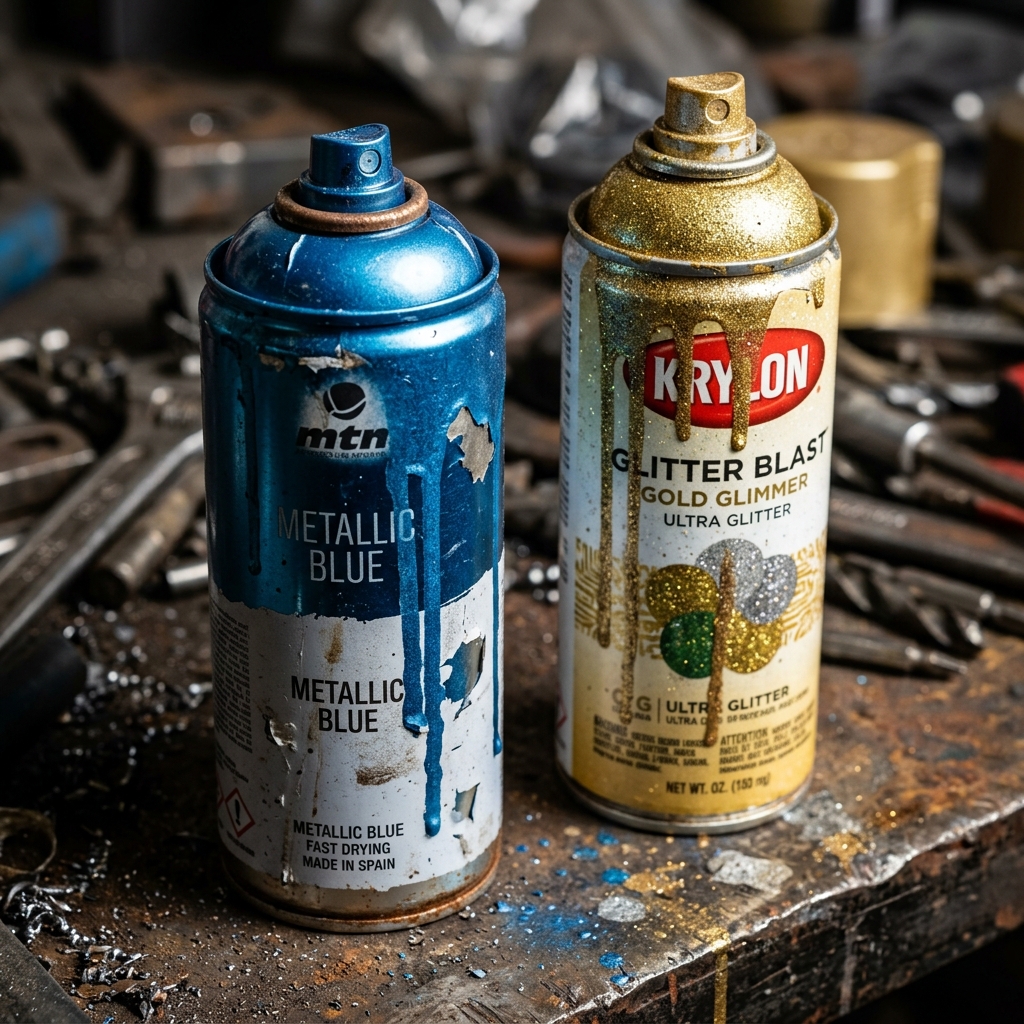
Aerosol spray paints — including metallic spray paint, glitter spray, zinc-rich sprays, cold galvanizing sprays, automotive aerosols, and industrial protective coatings — are created for convenience and professional-quality results. Yet defects like peeling, dullness, or uneven finish still happen. Understanding the physical chemistry, material science, and mechanical operations behind these defects is critical to ensuring consistent, durable coatings performance.
Guide Contents
1. Surface Preparation Issues
Surface contamination such as oils, mould-release residue, and oxidation is the single most common root cause behind the fisheye and adhesion defects covered below. Standardised adhesion and surface-preparation test methods for coatings are published by ASTM International, giving manufacturers a repeatable basis for qualifying a substrate before production.
Achieving a durable coating starts long before the paint is actually sprayed. The presence of microscopic dirt, oils, moisture, or chemical residues on the metal substrate will prevent proper molecular bonding of the paint film. Preparing the surface by sanding glossy areas and degreasing metal surfaces is crucial for adhesion. The following list details the primary surface preparation failures that compromise coating adhesion:
- Contamination Barrier: Dust, grease, finger oils, or moisture build-up preventing direct adhesion to the substrate.
- Lack of Mechanical Keying: Glossy, smooth, or unprimed surfaces resisting chemical bond formation, causing paint to flake off.
- Interfacial Gases: Invisible chemical contaminants or salts triggering osmotic blistering, peeling, or corrosion under the cured film.
2. Film Formation Challenges
Film formation is governed by the same solvent and binder chemistry covered in our guide to aerosol chemistry 101, and by whether the finished aerosol is a single-phase solution or a suspension of pigment, as explained in types of aerosol systems.
As the paint droplets leave the nozzle, they must coalesce into a continuous, flat liquid layer before curing. Improper application technique or fast solvent evaporation can interrupt this levelling process, resulting in severe surface defects. Controlling the film build thickness prevents sag runs while maintaining surface smoothness. Below are the key film formation challenges commonly encountered during spray applications:
- Paint Sag and Runs: Too much paint applied in a single pass, exceeding the critical film weight and causing vertical flow lines.
- Orange Peel and Roughness: Drying happens too quickly, preventing the liquid droplets from fully coalescing and flattening.
- Pinhole and Solvent Popping: Solvents trapped under a skinned-over surface layer popping through, leaving micro-craters.
3. Additive Performance Issues
Additive selection follows published test methods so that raw materials can be compared consistently; classification and evaluation standards are maintained by ASTM International and ISO.
Paint formulations rely on a balanced package of active additives to optimize leveling, dispersion, and gloss stability. When these additives are out of balance or degrade in storage, the visual properties and corrosion protection of the coating are severely diminished. Correct leveling additives prevent paint defects on vertical steel structures. The following list outlines typical failures related to incorrect or missing additive packages:
- Gloss Drift: Coatings turning dull, hazy, or rough due to poor pigment wetting or incorrect matting agent ratios.
- Metallic Patchiness: Metallic or glitter flakes settling unevenly, creating dark/light areas instead of a homogeneous sheen.
- Sacrificial Efficiency Loss: In zinc-rich primers, incorrect dispersing agents preventing electrical contact between zinc particles, leading to early rust.
4. Environmental Influences
Ambient temperature and humidity change solvent evaporation rate, which is the same underlying physics that drives propellant vapour pressure — see our comparison of aerosol propellants.
Ambient atmospheric conditions during spray application play a critical role in how the paint film cures and bonds. High humidity, freezing temperatures, or high winds can disrupt solvent evaporation rates and cause structural defects in the paint layer. Maintaining optimal spraying temperatures prevents solvent-locking. The primary environmental factors that accelerate aerosol paint failures are outlined below:
- Blushing and Haze: High ambient humidity causing water condensation on the wet film, resulting in a hazy or milky white finish.
- Soft Curing: Cold temperatures slowing down cross-linking and solvent release, leaving the film tacky and vulnerable to scuffs.
- Dry Spray: Intense heat evaporating solvent before the spray reaches the target, causing dry, sandy surface textures.
5. Mechanical & Handling Failures
Many mechanical defects trace back to the can and valve rather than the paint film. Our guides to why aerosol cans leak and the aerosol filling line cover the packaging side of these failure modes.
A spray paint can is a pressurized mechanical device that depends on the integrity of the valve, dip tube, and actuator nozzle. If paint dries inside the valve orifice or the internal pressure escapes due to damage, the dispensing system will fail even if the formulation is correct. Shaking the can for the full recommended duration ensures uniform particle dispersion. The most common mechanical and handling hardware failures include:
- Valve Clogging: Residual paint drying inside the stem or spring chamber, completely blocking flow or causing continuous leakage.
- Spitting and Droplets: Uneven spray pattern or heavy drops from a damaged actuator, blocked vapor tap, or low propellant pressure.
- Pressure Loss: Loss of propellant gas through microscopic crimp leaks, leaving paint inside the can that cannot be expelled.
6. Long-Term Durability Problems
Long-term film performance is normally verified with accelerated exposure testing before launch, following the same established-test philosophy used for container corrosion in our study of corrosion in water-based aerosol cans.
Once the paint has dried and cured, it must withstand ongoing physical and chemical stress from the surrounding environment. Over time, exposure to solar radiation, chemical cleaners, moisture, and abrasive wear will degrade the polymer matrix and cause adhesion loss. Formulating coatings with UV stabilizers helps prevent weathering. The primary drivers of long-term coating durability failures are detailed below: UV and weathering resistance is typically qualified against accelerated exposure standards such as ASTM G154, referenced through the same ASTM International library used for the container and adhesion tests elsewhere in this guide.
- Chalking and Fading: UV-induced degradation of the binder resin, turning the paint powdery and washing out the color pigments.
- Intercoat Adhesion Loss: Moisture penetrating between topcoat and primer layers, triggering broad delamination or peeling sheets.
- Corrosion Creep: Rust spreading under the film from scratches, breaking the adhesive bond of adjacent sound coating areas.
7. The Human Factor
Consistent results ultimately depend on repeatable process control across formulation, filling, and application, which is why manufacturers formalise it through the stages set out in Aerosol Manufacturing 101.
Many paint defects are not caused by formulation or hardware issues, but by incorrect application techniques. Spraying too close to the surface, applying excessively thick layers, or failing to shake the can sufficiently will lead to uneven dispersion and curing defects. Adhering to the manufacturer's distance guidelines prevents drips. The following list highlights the most common application mistakes made by users: Regulatory bodies such as the US EPA aerosol coatings programme also require label instructions covering spray distance and ventilation precisely because misapplication is a documented, recurring failure mode.
- Insufficient Mixing: Shaking the can too briefly, which leaves heavy pigments (and metallic flakes) settled at the bottom.
- Incorrect Spray Distance: Holding the can too close (leading to runs and bubbles) or too far (causing dry spray and dusting).
- Ignoring Recoat Windows: Spraying a new coat when the previous one is in the critical semi-cured state, causing wrinkling or cracking.
8. Conclusion
Aerosol paint failures result from multiple interacting factors: surface preparation, film formation, additives, environmental conditions, mechanical systems, and application technique. Addressing each factor systematically ensures durable, professional-quality results across all products — from glitter spray and metallic spray paint to zinc spray and industrial coatings.
For chemical manufacturers and brands, ensuring that the aerosol formulation integrates the correct leveling agents, dispersants, and propellant ratios is key to preventing customer complaints and product returns.
Frequently Asked Questions
Why does aerosol spray paint show fisheye defects?
What causes orange peel texture in aerosol coatings?
Why do runs and sags happen on vertical surfaces?
Why does metallic spray paint sometimes look mottled or streaky?
Why does aerosol paint sometimes fail to adhere to the substrate?
How does humidity affect aerosol spray paint application?
Troubleshooting Paint Formulation Defects?
Partner with Global Aerosols to audit your aerosol spray paint chemistry. Solve issues with leveling, metallic settling, nozzle clogging, and shelf-life pressure stability.
Email: consulting@globalaerosols.com
Website: https://www.globalaerosols.com
Phone: +91 9819548320 +91 8169102990
About the Specialist
Absar Khan is the founder and lead aerosol consultant at Global Aerosols. He possesses cross-disciplinary engineering expertise spanning aerosol coatings and paint chemistry, application troubleshooting, propellant systems, and regulatory compliance. Absar leads scientific and engineering advisory teams supporting manufacturers globally in technology selection, GMP layouts, validation frameworks, and regulatory strategies.
LinkedIn Portfolio: Connect with Absar Khan on LinkedIn