Metered Dose Valve Engineering: Dose Accuracy, Consistency & Leak Standards

Guide Contents
A metered dose valve is a precision aerosol valve that delivers a fixed, reproducible quantity of product with every actuation — regardless of canister fill level, actuation force, or orientation. It achieves this through a small internal metering chamber whose volume is defined during manufacture, filling on the upstroke and discharging completely on the downstroke. This engineering precision makes metered dose valves the foundation of pharmaceutical inhaler technology, topical drug delivery, and any aerosol application where an inconsistent dose creates a safety, efficacy, or regulatory problem.
Understanding how metered dose valves are designed, how their dose accuracy is characterised, and what failure modes affect their leak performance is essential knowledge for aerosol formulators, product development engineers, and quality assurance teams working across both pharmaceutical and industrial aerosol sectors. This guide provides a complete technical overview of MDV engineering — covering component function, dose variability mechanisms, gasket compatibility, leak standards, and QC testing protocols.
What Is a Metered Dose Valve?
A metered dose valve (MDV) is a subtype of aerosol dispensing valve engineered to deliver a pre-defined unit volume of product per actuation cycle. Unlike continuous spray valves, which allow product to flow for as long as the actuator is depressed, an MDV physically limits each discharge to the volume of its internal metering chamber — typically expressed in microlitres (µL) for pharmaceutical applications or in milligrams (mg) of spray weight for consumer aerosols. The principle is mechanically elegant: the metering chamber fills passively between actuations and is isolated from the bulk formulation at the moment of delivery.
Metered dose valves are most prominently associated with pressurised Metered Dose Inhalers (pMDIs), where each actuation must deliver a precise drug dose to the patient's airways. However, the same valve class is used in topical pharmaceutical sprays, metered-dose nasal sprays, and certain precision industrial applications. As detailed in our guide to aerosol propellants, the propellant system interacts intimately with valve design — propellant vapour pressure, density, and solvent properties all influence whether the metering chamber fills and empties with the reproducibility that MDV engineering demands.
- MDVs deliver a fixed volume per actuation, independent of canister pressure at time of use
- Standard chamber volumes range from approximately 25 µL to 100 µL in pharmaceutical applications, and up to several hundred µL in consumer metered sprays
- The valve housing, stem, metering chamber body, inlet gasket, and outlet gasket are the five primary subcomponents
- MDVs may be designed for upright, inverted, or any-orientation use depending on dip tube and chamber geometry
Valve Anatomy & Component Functions
The metered dose valve is a multi-component precision assembly in which every element has a defined engineering function. Failure or dimensional drift in any single component propagates directly into delivered dose variability or leak failure — which is why MDV manufacturing tolerances are among the tightest in the consumer goods or pharmaceutical packaging supply chain. Understanding the function of each component is the prerequisite for diagnosing dose inconsistency, selecting compatible materials, and specifying qualification tests. The aerosol valve gasket in particular deserves attention as the component most sensitive to formulation chemistry.
| Component | Primary Function | Key Engineering Parameter |
|---|---|---|
| Valve Housing (Body) | Encases all internal components; interfaces with the aerosol can cup via a crimp | Dimensional accuracy at crimp seat; internal bore concentricity |
| Metering Chamber | Defines the exact volume delivered per actuation | Chamber volume tolerance (typically ±2–5% for pharmaceutical MDIs) |
| Valve Stem | Translates actuator depression into port opening/closing sequence | Stem length, travel distance, and orifice diameter |
| Return Spring | Resets stem to closed position after each actuation | Spring constant — too stiff increases actuation force; too weak causes incomplete closure |
| Inlet (Tank) Gasket | Seals metering chamber from bulk formulation between actuations; opens on upstroke to allow fill | Elastomer grade, swell resistance, and sealing force |
| Outlet (Stem) Gasket | Maintains can pressure seal when valve is at rest; opens on downstroke to allow dose discharge | Creep resistance under sustained propellant pressure |
| Dip Tube | Delivers liquid formulation from the can base to the valve inlet in upright-use products | Internal diameter, length, and material compatibility |
| Valve Cup | The metal disc crimped onto the aerosol can opening, housing the valve assembly | Crimp dimensions and sealing geometry per aerosol can standard |
The inlet and outlet gaskets operate in a precisely sequenced manner. On downstroke (actuation), the stem first closes the inlet port — isolating the metering chamber from the bulk formulation — and then opens the outlet port, allowing the metered volume to discharge through the stem orifice and actuator. On upstroke (release), the outlet closes before the inlet reopens, allowing the bulk formulation to refill the metering chamber for the next dose. This sequencing is governed entirely by the geometry of the stem and housing; there are no active control elements.
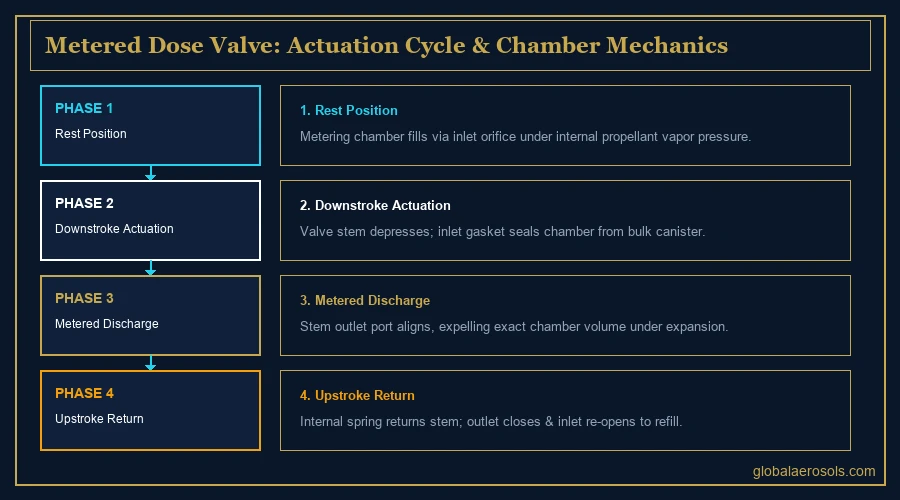
Metered dose valve components in laboratory precision measurement — the metering chamber fill-and-discharge cycle is the fundamental mechanism controlling aerosol dose accuracy.
Dose Accuracy: Engineering Determinants
Dose accuracy in a metered dose valve is the outcome of a tight engineering system — not a single component property. Every dimensional variable in the valve assembly contributes to the statistical distribution of delivered doses measured across an actuation sequence. In pharmaceutical MDI development, regulators expect manufacturers to characterise this distribution through dose uniformity testing at the beginning, middle, and end of canister life, demonstrating that delivered doses remain within an acceptable range throughout the product shelf life. For consumer aerosol products, while regulatory requirements are less stringent, consistent dose weight directly affects consumer perception of product quality.
The principal engineering variables that determine dose accuracy include:
- Metering chamber volume precision: Injection-moulded polymer chambers carry inherent dimensional variation. Tolerances tighter than ±2% of nominal volume require high-precision tooling and rigorous in-process dimensional monitoring.
- Inlet orifice geometry: The inlet orifice determines how quickly the metering chamber refills between actuations. If the orifice is too small, rapid repeat actuations may deliver sub-dose volumes because the chamber has not fully refilled.
- Stem travel distance: The distance the stem travels on actuation must fully open the outlet orifice to allow complete chamber emptying. Insufficient stem travel causes partial discharge — the single most common cause of low-dose actuation failures.
- Gasket sealing integrity: An inlet gasket that does not seal fully allows bulk formulation to bleed into the metering chamber during discharge, increasing the delivered dose unpredictably. An outlet gasket that does not fully reseal allows pressure leakage between actuations, affecting subsequent dose volumes.
- Formulation viscosity and density: High-viscosity formulations fill the metering chamber more slowly, making dose volume sensitive to the dwell time between consecutive actuations.
- Temperature effects: Propellant vapour pressure is temperature-dependent. At higher temperatures, elevated pressure within the can increases the force driving formulation into the metering chamber and affects the thermodynamic state of the formulation at the point of discharge.
According to ASTM International, the test method ASTM D5964 provides a standardised procedure for measuring aerosol spray rate — a commonly used proxy for valve consistency in consumer aerosol quality control, where individual dose weighing per actuation is not routinely feasible.
Leak Performance & Industry Standards
Aerosol valve leak performance is a product safety and regulatory compliance issue of the highest importance. A leaking valve compromises product integrity, creates fire and explosion hazards in storage environments, exposes users to propellant inhalation, and results in non-conformance with the regulations that govern aerosol products in every major market. Leak performance in metered dose valves is more demanding than in continuous spray valves because the MDV must maintain a seal at both the inlet and outlet gasket simultaneously throughout the product shelf life — under conditions of sustained propellant pressure, formulation exposure, and cyclic thermal stress.
| Standard / Regulation | Jurisdiction | Relevance to MDV Leak Performance |
|---|---|---|
| EU Aerosol Dispensers Directive 75/324/EEC | European Union | Sets maximum permissible leak rate for finished aerosol products; defines hot water bath test conditions |
| ASTM D3925 | International / US | Standard practice for aerosol dispensers — includes leak detection during filling and at finished product QC stage |
| ICH Q1A (Stability Testing) | Pharmaceutical (Global) | Requires leak rate measurement at defined stability time points to confirm product integrity over shelf life |
| USP <601> / Ph.Eur. 2.9.44 | Pharmaceutical (US / EU) | Pharmacopoeial leak rate limits for pressurised inhalation aerosols; specifies measurement method |
| ISO 9001 Quality Systems | International | Framework for systematic in-process and finished product leak testing as part of the quality management system |
The EU Aerosol Dispensers Directive — available in full text at EUR-Lex — requires that aerosol dispensers are tested by immersion in a water bath at 50°C and that any product showing leakage fails the test. For metered dose valve assemblies, this test assesses the integrity of the complete sealing system — not merely the outlet gasket. Products showing visible bubbling, deformation, or pressure equalisation during the hot water test are rejected. This test is universally employed during filling line qualification and periodic production sampling across both consumer and pharmaceutical aerosol manufacturing.
Valve leak performance is assessed through a combination of hot water bath testing, gravimetric leak rate measurement, and formulation-specific compatibility studies over the product shelf life.
Gasket Material Selection for Metered Dose Valves
The elastomer gaskets within a metered dose valve are the component most vulnerable to chemical attack from the formulation and propellant system. Unlike metallic valve components — which are largely chemically inert — elastomer gaskets can absorb propellant, swell in the presence of organic solvents, harden through plasticiser extraction, or leach compounding agents into the formulation. For pharmaceutical MDIs, gasket materials are regulatory substances of interest because extractables and leachables from elastomers must be characterised and assessed against inhalation toxicological thresholds as required by FDA and EMA guidelines.
This makes the gasket qualification process one of the most time-consuming elements of MDV product development. As covered in our technical overview of aerosol valve gaskets, the interaction between the elastomer and the formulation must be evaluated for dimensional swell, weight change, tensile property retention, and leachables profile before an elastomer grade is released for production use. The ECHA REACH regulation also applies to gasket compounding agents used in aerosol products placed on the EU market, adding a chemical registration dimension to material selection.
| Elastomer Class | Typical Use Case | Key Properties | Limitations |
|---|---|---|---|
| EPDM | HFA-propelled pharmaceutical MDIs; water-based aerosols | Excellent HFA compatibility; low extractables when properly compounded; good compression set resistance | Poor resistance to hydrocarbon solvents and LPG propellants |
| Buna-N (Nitrile / NBR) | LPG-propelled consumer aerosols; solvent-based products | Good hydrocarbon resistance; cost-effective; wide availability of compound grades | Not suitable for HFA or acetone-containing formulations |
| Neoprene (Polychloroprene) | General industrial aerosols; products containing DME | Moderate solvent resistance; good mechanical durability; stable dimensional properties | Inferior to EPDM for HFA; some grades extract chlorinated compounds into formulation |
| Thermoplastic Elastomers (TPE/TPV) | Speciality pharmaceutical and personal care aerosols | Can be engineered for very low extractables; no cure system compounds; precise dimensional control | Higher material cost; compression set performance at elevated temperature must be carefully validated |
MDV vs Continuous Spray Valves: Technical Comparison
The choice between a metered dose valve and a continuous spray valve (CSV) is determined by the dose precision requirement of the product, not merely the intended application. Many aerosol products that appear to require precision — such as hair sprays or personal care mists — actually use continuous spray valves, because their performance depends on applied quantity being controlled by user judgement rather than mechanical metering. Conversely, pharmaceutical aerosols require metered dose valves as a non-negotiable design requirement because drug delivery safety depends on each actuation delivering a consistent pharmacological dose.
For a comprehensive technical grounding in how different propellant systems interact with valve type selection, our guide on how aerosol cans work provides the foundational context. The propellant's vapour pressure, its miscibility with the concentrate, and whether the formulation is a solution or suspension all affect which valve architecture delivers optimal performance. This is also relevant when considering the full aerosol manufacturing process as described in our Aerosol Manufacturing 101 guide.
| Parameter | Metered Dose Valve (MDV) | Continuous Spray Valve (CSV) |
|---|---|---|
| Dose per actuation | Fixed volume — defined by metering chamber | Variable — proportional to actuation duration |
| Primary application sectors | Pharmaceutical inhalers, topical drug sprays, precision industrial | Personal care, household, industrial, food |
| Regulatory requirement | Mandatory for pharmaceutical aerosols (pMDI) | Standard for consumer aerosol products |
| Component complexity | Higher — metering chamber, inlet/outlet gaskets, precision stem | Lower — fewer subcomponents, wider tolerance stack |
| Material qualification burden | High — extractables/leachables assessment for pharmaceutical use | Lower — compatibility testing for product-specific solvents and propellants |
| Unit cost | Higher — reflects precision manufacturing and tighter tolerances | Lower — high-volume commodity components |
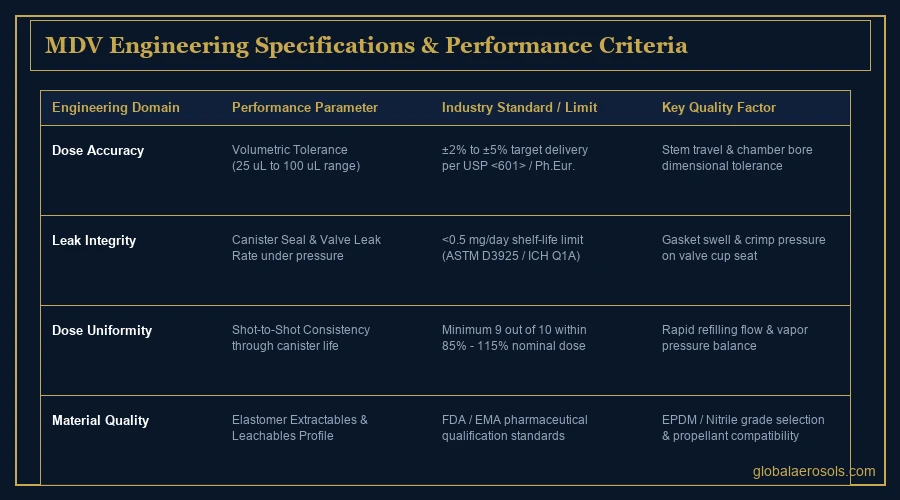
Metered dose valve engineering specifications and quality control performance criteria overview.
Testing & Quality Control for Metered Dose Valves
Quality control of metered dose valve performance spans the entire product lifecycle — from incoming component inspection, through in-process filling line checks, to finished product release testing and ongoing stability monitoring. The high precision required of MDVs means that quality failures at any stage can result in products with dose accuracy or leak performance outside specification, with potentially serious consequences in pharmaceutical applications. In consumer aerosol markets, valve QC failures manifest as user complaints about inconsistent spray output, premature emptying, or leaking products.
The British Aerosol Manufacturers' Association (BAMA) publishes technical guidance on aerosol quality control practices that includes recommended sampling frequencies, acceptance criteria, and test methods for valve performance at both component receipt and finished goods stages. Their guidance is aligned with the EU Aerosol Dispensers Directive requirements and provides a practical framework applicable to manufacturers serving European and international markets.
Key QC tests for metered dose valves include:
- Actuation force testing: Measures the force required to actuate the valve stem. Excessive actuation force indicates spring rate drift, gasket swelling, or stem/body interference. Insufficient force suggests spring fatigue or loss of sealing contact.
- Spray weight / dose weight per actuation: Gravimetric measurement of delivered mass per actuation across a defined number of shots. This is the primary functional measure of dose accuracy for both pharmaceutical and consumer aerosol products.
- Leak rate testing: Hot water bath immersion per EU Aerosol Dispensers Directive; gravimetric leak rate measurement (weight loss per unit time) for pharmaceutical products; electronic leak detection on high-speed filling lines using ultrasonic or pressure-decay methods.
- Total number of metered shots: Verification that the canister delivers at least the labelled number of actuations, confirming metering chamber function and fill weight accuracy over the complete product life.
- Valve crimp integrity: Dimensional inspection of the crimp geometry between valve cup and can opening — the primary seal against internal pressure loss outside the valve mechanism itself.
- Gasket swell testing: Immersion of gasket specimens in the formulation and/or propellant for defined durations at elevated temperature, measuring dimensional change, weight change, and mechanical property retention. Per PubChem, the propellant's solubility parameter and polarity index are reliable indicators of elastomer swell risk prior to physical testing.
Frequently Asked Questions
What is a metered dose valve in aerosol products?
How does a metered dose valve achieve consistent dose output?
What standards govern aerosol valve leak testing?
What materials are used for metered dose valve gaskets?
How is aerosol valve dose accuracy tested?
What causes dose-to-dose variability in metered dose valves?
What is the difference between a metered dose valve and a continuous spray valve?
Need Expert Aerosol Consulting?
Our team provides end-to-end aerosol technical consultancy — from formulation development and propellant selection to filling line setup, regulatory compliance, and market launch strategy.
Get a Free ConsultationRelated Articles
- Aerosol Valve Gasket Materials Explained
- Aerosol Crimping, Gassing & Leak Detection Explained
- Aerosol Manufacturing 101: The Complete Technical Guide
- How Aerosol Cans Work: Propellant, Pressure, Valve & Spray Dynamics
- Aerosol Propellants Explained: LPG vs DME vs HFC vs N₂ vs CO₂
- Aerosol Chemistry 101: Solvents, Binders, Surfactants & Additives
- From Lab to Factory: Aerosol R&D to Commercial Manufacturing
- How to Choose the Right Aerosol Product Consultant
Absar Khan
Absar Khan is a senior aerosol industry consultant with deep expertise spanning aerosol formulation, propellant technology, valve engineering, filling line setup, and regulatory compliance across global markets. His work integrates aerosol chemistry, GMP manufacturing practices, safety and flammability assessment, quality systems, and regulatory strategy for markets including India, the EU, and the US. As Founder and Lead Consultant at Global Aerosols, Absar leads technical and engineering teams delivering end-to-end aerosol solutions — from initial formulation and lab trials through pilot-scale testing, commercial manufacturing setup, and full market launch.