Aerosol Dry Lubricants: PTFE, MoS2 and Graphite Suspension Formulations

An aerosol dry lubricant is an engineered industrial coating designed to deposit a solid, friction-reducing film that dries instantly without leaving a wet or tacky residue. It works by dispensing micro-fine solid particles—such as PTFE, molybdenum disulfide (MoS2), or graphite—suspended within a fast-evaporating solvent carrier. This matters for industrial engineers and maintenance professionals because dry film lubricants provide critical wear protection in environments where conventional wet oils would attract abrasive dust, dirt, or contaminants. By establishing a low-friction boundary layer that bonds directly to the substrate, a high-performance solid lubricant suspension spray dramatically extends the operational lifespan of moving parts under extreme loads and temperatures.
Chemistry of Solid Lubricant Suspensions
Aerosol dry lubricant formulations rely entirely on the stable dispersion of insoluble solid particles within a complex liquid carrier system. Unlike conventional penetrating oils or traditional aerosol chemistries where the active ingredient is completely dissolved, a solid lubricant suspension spray requires sophisticated rheological engineering. The formulation must precisely balance particle size distribution, solvent evaporation rates, and advanced resin binders to ensure the solid lubricant does not irreversibly agglomerate during storage. This ensures the dry film lubricant aerosol is delivered uniformly to the target surface without clogging the precision actuator.

Microscopic view of solid lubricant particles precipitating from the solvent carrier to form a uniform dry film boundary layer.
PTFE Aerosol Lubricant Mechanisms
Polytetrafluoroethylene (PTFE) remains one of the most broadly specified active ingredients in light-duty industrial applications due to its exceptionally low coefficient of friction. When dispensed as a PTFE aerosol lubricant, the microscopic fluoropolymer particles rapidly bond to the metallic or polymer substrate, effectively filling in microscopic surface asperities. According to data available through PubChem, PTFE's highly inert molecular structure allows it to establish a remarkably smooth, non-stick dry film layer that repels moisture, resists most harsh chemicals, and prevents galling during sliding friction. This makes it an essential choice for cleanroom environments, textile machinery, and intricate mechanisms where traditional chain lubricant aerosols would cause unacceptable contamination.
| Property | PTFE (Polytetrafluoroethylene) | MoS2 (Molybdenum Disulfide) | Graphite |
|---|---|---|---|
| Coefficient of Friction | 0.04 - 0.10 | 0.03 - 0.06 | 0.10 - 0.15 |
| Max Operating Temperature | ~260°C (500°F) | ~400°C (750°F) | ~538°C (1000°F) |
| Application Environment | Clean, light load, plastic-safe | Heavy load, extreme pressure | High temperature, dusty areas |
| Visual Appearance | White / Translucent | Dark Grey / Black | Black |
MoS2 Spray Lubricant for Extreme Pressures
Molybdenum disulfide (MoS2) represents a fundamental departure from fluoropolymers, leveraging a unique crystalline architecture composed of molybdenum atoms sandwiched between layers of sulfur atoms. An MoS2 spray lubricant relies on this lamellar structure to deliver exceptional boundary lubrication; the inherently weak van der Waals forces between the sulfur planes allow them to slide past one another with minimal mechanical resistance. Standardized wear tests, such as those governed by ASTM D4172 for lubricating fluids, demonstrate that MoS2 excels in extreme pressure (EP) applications where heavy loads would otherwise displace a conventional liquid oil or easily strip away a softer PTFE dry film.
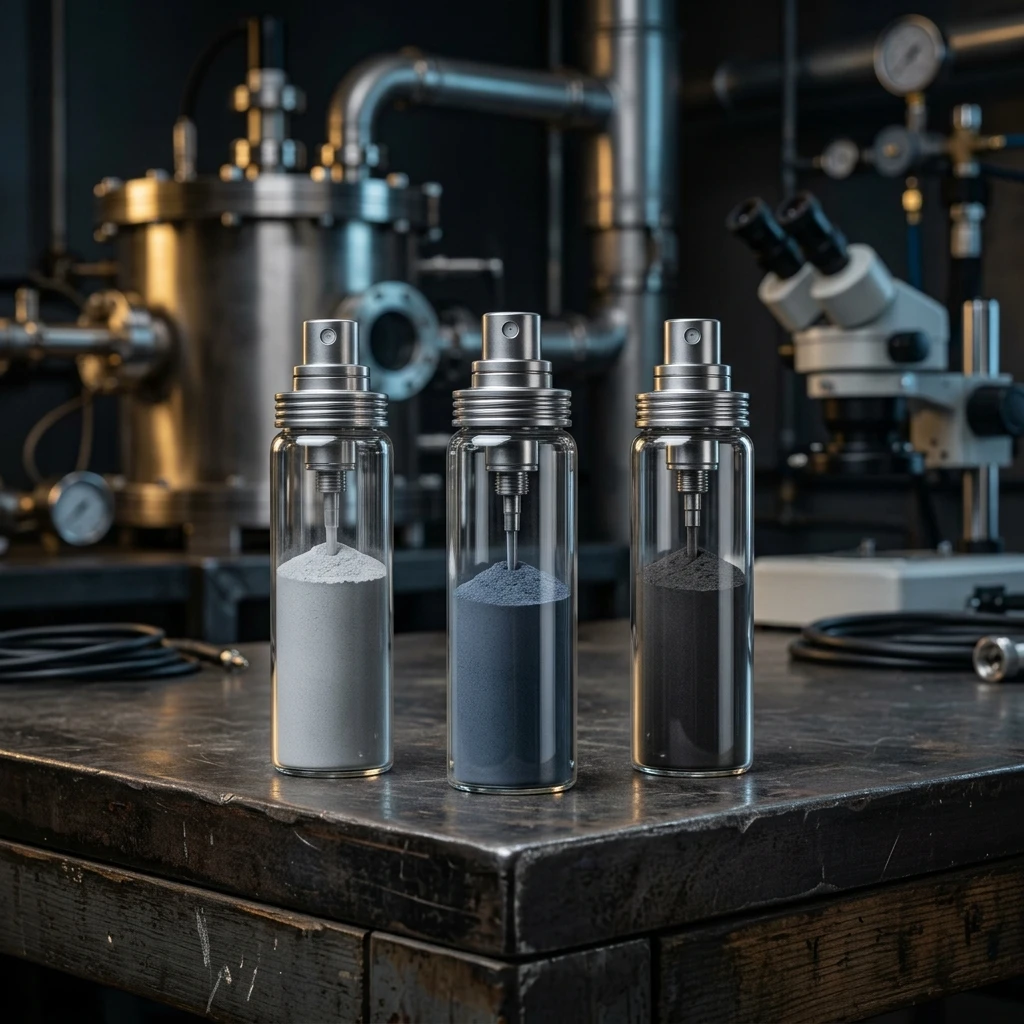
Comparison of PTFE, MoS2, and Graphite solid lubricant suspensions showing respective application environments.
Graphite Dry Lubricant for High Temperatures
While graphite shares a similar lamellar structure to MoS2, its lubricating mechanism fundamentally depends on the presence of absorbed moisture or ambient gases intercalated between its graphene layers. A graphite dry lubricant aerosol is typically specified for extremely high-temperature industrial environments where both PTFE and MoS2 would thermally degrade, oxidize, or fail entirely. Formulators frequently target heavy-duty applications—such as kiln car bearings, foundry operations, and high-temperature forging processes—where operating temperatures routinely exceed 400°C and traditional liquid lubricants would immediately ignite or evaporate.
Binder Systems in Dry Film Lubricants
The ultimate durability of any dry film lubricant aerosol depends heavily on the chemical composition and curing profile of its integrated binder system. The binder acts as the polymeric resin dissolved within the solvent blend, designed to adhere the solid lubricant particles tenaciously to the substrate the moment the solvent flashes off. Industrial chemists must carefully select specific resins—such as robust acrylics, thermosetting epoxies, or rapid-drying cellulosics—tailored precisely to the target application's requisite adhesion strength, expected cure time, and resistance to environmental chemical attack. If a weak binder is utilized, the resultant dry film will prematurely dust off under friction, whereas an excessively aggressive binder can mask the lubricating properties of the active solid particles.
Propellant and Solvent Delivery Systems
In the formulation of a solid lubricant suspension spray, the selected propellant and volatile solvent blend function as the critical delivery and dispersion mechanism. The solvent must be engineered to evaporate at a precisely controlled rate, allowing the applied film sufficient time to level out smoothly before fully drying, while strictly adhering to workplace handling protocols for flammable liquids as outlined by OSHA. Simultaneously, the aerosol propellant must generate adequate internal pressure to thoroughly atomize the dense solid particles; if the aerosol propellants expand too violently upon exiting the actuator, the resulting turbulent blast can physically blow the dry powder off the substrate during application rather than allowing it to coat the surface evenly.
Frequently Asked Questions
What is an aerosol dry lubricant?
How does a PTFE aerosol lubricant differ from a silicone spray?
When should I select an MoS2 spray lubricant over graphite?
Why do dry film lubricant aerosols require vigorous shaking before use?
Can an aerosol dry lubricant be applied to plastic or rubber components?
What role does the binder play in a dry film lubricant aerosol?
Need Expert Aerosol Consulting?
Our team provides end-to-end aerosol technical consultancy — from formulation development and propellant selection to filling line setup, regulatory compliance, and market launch strategy.
Get a Free Consultation