Aerosol Valve Gasket Compatibility: DME, Ethanol & Water-Based Systems
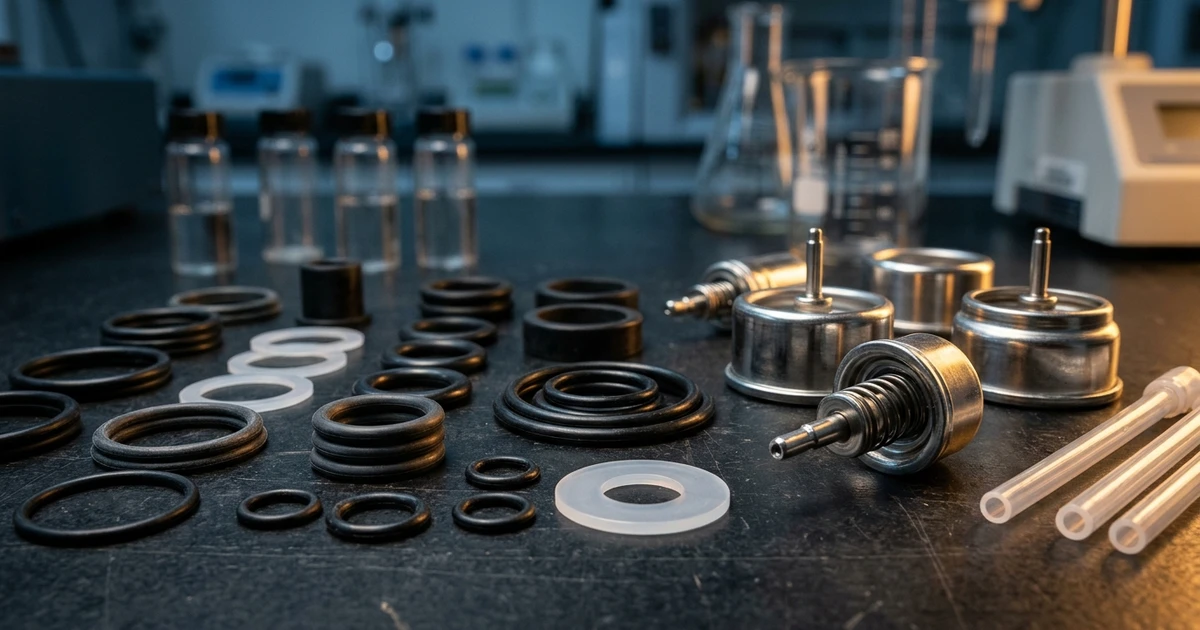
Aerosol valve gasket compatibility is the foundational engineering requirement that guarantees pressurized containment, structural sealing force, and smooth mechanical valve actuation across the complete operational lifespan of a packaged aerosol product. When aerosol formulators incorporate polar oxygenated solvents like ethanol alongside high-solvency propellants such as dimethyl ether (DME) in modern water-based aerosols, commercial elastomer seals experience profound thermodynamic interactions that standard hydrocarbon blends never induce. Incompatible valve cup or stem gaskets can suffer severe volumetric swelling, rapid plasticizer extraction, or premature embrittlement, directly causing catastrophic crimp relaxation, continuous micro-leakage, or valve stem seizure. This engineering guide details the chemical solvation mechanisms governing polymer degradation, compares Buna-N, Neoprene, Butyl, and EPDM elastomeric responses, evaluates ternary solvent swell kinetics, and establishes rigorous crimp dimensional tolerance and accelerated immersion testing protocols. For broader system context, explore our technical breakdown of aerosol propellants and valve systems, our structural analysis in aerosol valve gasket materials explained, and our detailed propellant monograph in the dimethyl ether (DME) aerosol propellant guide.
The Chemical Mechanism of Elastomer Swelling and Solvation
Elastomer swelling in aerosol packaging is driven by fundamental thermodynamic diffusion, wherein solvent and liquefied propellant molecules penetrate the intermolecular voids of a vulcanized polymer network. When the chemical nature of the solvent matches the polymer backbone, solvent molecules disrupt secondary van der Waals forces between polymer chains, forcing them apart and inducing measurable volumetric expansion. In aerosol valve assemblies, this physical-chemical interaction governs whether a gasket maintains its pre-stressed sealing compression or suffers structural failure.
The extent of polymer swell is governed by Hansen solubility parameters (HSP), which dissect total cohesive energy density into three distinct components: dispersion forces (δD), polar dipole-dipole interactions (δP), and hydrogen bonding affinity (δH). Conventional liquefied petroleum gas (LPG) propellants, composed predominantly of propane, isobutane, and n-butane, possess virtually zero dipole moment and negligible hydrogen bonding capacity, interacting purely through non-polar dispersion forces. In contrast, dimethyl ether (CH3-O-CH3) exhibits an ether oxygen dipole that introduces significant polar character (δP ≈ 6.0 MPa1/2) and moderate hydrogen bonding capability (δH ≈ 5.8 MPa1/2), as cataloged in authoritative thermodynamic databases such as PubChem chemical database.
When DME is introduced into an aerosol container, its compact molecular geometry and dipolar nature enable rapid diffusion into rubber matrices that contain polar functional groups. The thermodynamics of this process follow the Flory-Rehner theory of rubber elasticity, which balances the osmotic mixing pressure of the solvent against the elastic retractile forces of the crosslinked vulcanizate network:
- Osmotic Diffusion Force: Solvents with solubility parameters close to the polymer exhibit negative free energy of mixing (ΔGmix < 0), actively driving solvent ingress into the elastomer matrix.
- Crosslink Density Constraint: Highly crosslinked vulcanizates generate opposing elastic retractile forces that limit maximum equilibrium swell, whereas loosely crosslinked polymers expand unchecked.
- Plasticizer Extraction Disruption: Concurrently, polar solvents leach out low-molecular-weight processing plasticizers and ester extenders, permanently altering the elastomer's glass transition temperature (Tg).
- Equilibrium Dynamic: Once thermodynamic equilibrium is reached, the swollen gasket exhibits reduced tensile modulus, altered viscoelastic compliance, and expanded physical dimensions.
Understanding this molecular solvation balance is critical for preventing sudden valve failure in commercial aerosol production. If the solvent affinity is too high, unconstrained polymer expansion causes dimensional distortion; if the solvent selectively extracts compounding aids without swelling the base polymer, the gasket shrinks and hardens. Both extremes compromise the hermetic barrier required for long-term aerosol stability.
Aerosol Valve Gasket Compatibility: Buna-N, Neoprene, Butyl, and EPDM
Selecting the correct elastomeric formulation requires analyzing the chemical compatibility between specific commercial rubber backbones and the solvent-propellant matrix. The five primary elastomer families utilized in commercial aerosol valve manufacturing—nitrile rubber (Buna-N / NBR), chloroprene (Neoprene / CR), butyl rubber (IIR / CIIR / BIIR), ethylene propylene diene monomer (EPDM), and fluoroelastomers (FKM / Viton)—each exhibit distinct physical-chemical resistance profiles when challenged by polar propellants and alcohol cosolvents.
Nitrile butadiene rubber (Buna-N) is the historical workhorse of the aerosol industry, engineered specifically for non-polar aliphatic hydrocarbons. The acrylonitrile (ACN) content in Buna-N imparts polar resistance against petroleum oils and aliphatic LPG propellants. However, this same polar acrylonitrile group creates an intense chemical affinity for dimethyl ether and short-chain alcohols. In systems containing elevated levels of DME and ethanol, standard Buna-N compounds undergo severe volumetric swell, often exceeding +35% to +60% within weeks of packaging, which completely destroys crimp integrity and valve function.
| Elastomer Polymer Class | Polymer Backbone & Polarity | DME Propellant Resistance | Ethanol Cosolvent Resistance | Water-Based System Compatibility | Primary Failure Mode Under Swell |
|---|---|---|---|---|---|
| Buna-N (NBR) | Acrylonitrile-butadiene copolymer; moderate-to-high polarity | Poor; severe volumetric swell (+30% to +60%) | Moderate; acceptable at low alcohol levels | Good hydrolytic stability; poor solvent resistance | Radial extrusion from mounting cup; stem orifice pinching |
| Neoprene (CR) | Polychloroprene; polar allylic chlorine structure | Moderate-to-poor; significant swell (+20% to +45%) | Moderate; softens under continuous exposure | Moderate; susceptible to slow plasticizer loss | Collet crimp relaxation; loss of compression recovery |
| Butyl Rubber (IIR / BIIR) | Polyisobutylene-isoprene copolymer; low polarity | Good; controlled swell (+8% to +18%) | Excellent; virtually inert to polar alcohols | Outstanding moisture vapor barrier; excellent stability | Slow compression set under elevated warehouse heat |
| EPDM | Ethylene-propylene-diene terpolymer; completely non-polar | Fair-to-moderate; moderate swell (+15% to +25%) | Outstanding; near-zero swell in pure alcohols | Superior; fully immune to aqueous hydrolysis | Accelerated swell in presence of non-polar mineral oils |
| Fluoroelastomer (FKM) | Fluorinated hydrocarbon; high fluorine electronegativity | Moderate-to-poor in low-MW ethers; variable | Good to excellent; highly resistant to alcohols | Outstanding; impervious to moisture and oxidation | Prohibitive cost; high durometer causing crimp leakage |
Chloroprene (Neoprene) offers slightly improved resilience compared to standard NBR in mild solvent systems, but its chlorine-substituted unsaturated backbone remains vulnerable to rapid swelling in pure DME. Butyl rubber, particularly chlorinated (CIIR) or brominated (BIIR) halobutyl grades, presents an exceptionally tight molecular structure and minimal polarity, resulting in superior gas barrier properties and controlled swell in ethanol and water-based formulations. Engineers validating these material grades rely on standardized coupon testing guided by international elastomer standards from ASTM International, specifically ASTM D471 for liquid immersion swell metrics.
For modern water-based aerosols utilizing DME and ethanol, ethylene propylene diene monomer (EPDM) and specialized bromobutyl grades emerge as the preferred commercial polymers. EPDM’s fully saturated hydrocarbon backbone resists alcohol penetration and completely avoids aqueous hydrolytic degradation. However, formulators must recognize that EPDM swells dramatically in the presence of non-polar mineral spirits, petroleum distillates, or hydrocarbon propellants, making polymer selection strictly dependent on the total formulation composition rather than any single constituent in isolation.
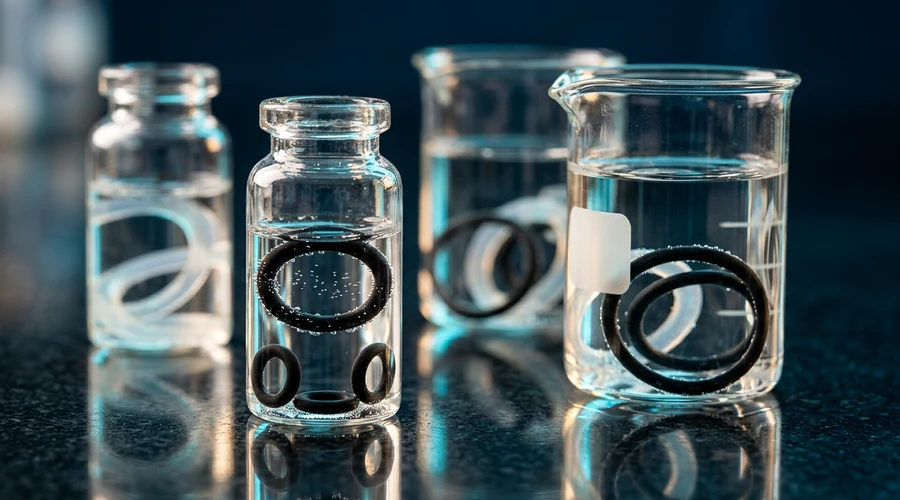
Laboratory swell immersion testing of diverse elastomer test coupons submerged in polar dimethyl ether (DME) and ethanol solvents within borosilicate glass vessels.
DME and Ethanol Synergistic Effects in Water-Based Formulations
In modern low-VOC and water-based aerosol products, formulators frequently combine water, ethanol, and dimethyl ether into a unified single-phase or micro-emulsified system. Dimethyl ether exhibits unique physical properties among aerosol propellants because it dissolves substantial quantities of water at ambient temperatures, while ethanol acts as a mutual bridging cosolvent that establishes a completely homogeneous liquid phase. However, this ternary solvent blend creates complex, non-linear chemical swell kinetics that cannot be predicted by evaluating individual ingredients in isolation.
When an aerosol valve gasket is immersed in a ternary water-ethanol-DME mixture, competitive diffusion and preferential polymer absorption occur simultaneously. Dimethyl ether possesses a significantly smaller molar volume and higher vapor pressure than ethanol, allowing DME molecules to rapidly permeate the outer boundary layer of the rubber gasket within the first several hours following gas filling. As DME penetrates the polymer chains, it dilates the elastomer network, expanding intermolecular spacing and dramatically increasing the diffusion rate for larger ethanol molecules that follow.
This cooperative plasticization phenomenon often results in volumetric swell percentages that exceed the additive sum of individual components. A vulcanizate that demonstrates an acceptable +8% swell in pure ethanol and +12% swell in pure DME may experience an unacceptable +28% swell when exposed to a balanced water-ethanol-DME formulation. Furthermore, the presence of dissolved water introduces osmotic pressure differentials within hydrophilic or ionic compounding residues (such as metal oxide activators or clay fillers), promoting micro-cavitation and structural blistering inside the gasket core.
To mitigate synergistic swell, packaging engineers must evaluate polymer crosslinking chemistry. Peroxide-cured elastomers consistently outperform traditional sulfur-vulcanized systems when challenged by polar ternary blends. Peroxide cures produce rigid carbon-carbon crosslinks (C-C) between polymer backbones, whereas sulfur cures rely on flexible mono-, di-, and poly-sulfidic bridges (C-Sx-C) that are susceptible to solvent-assisted cleavage and high viscoelastic creep under continuous internal container pressure.
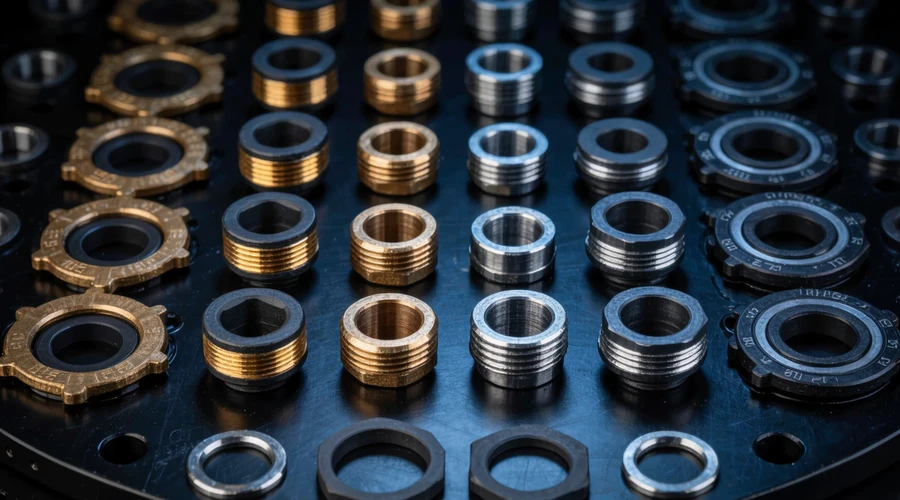
Comparative overview of elastomer swell behavior, crosslink degradation, and radial sealing force retention across common aerosol valve gasket polymers.
Valve Crimp Mechanics and Dimensional Tolerance Under Swell
The mechanical integrity of an aerosol package depends on the radial compression generated when the 1-inch (25.4 mm) tinplate or aluminum valve mounting cup is crimped into the circular curl of the container neck. Within this joint, the valve cup gasket serves as the resilient sealing element that fills micro-imperfections in the metal surface and absorbs mechanical shock during distribution. The physical deformation of this gasket under continuous chemical exposure directly determines whether the crimped joint remains hermetically sealed or fails catastrophically.
During automated valve crimping on commercial aerosol lines, expanding collet fingers depress the mounting cup and force its skirt radially outward beneath the container curl. Standard engineering specifications mandate precise control over crimp diameter (typically 27.05 ± 0.10 mm for standard tinplate containers) and crimp height or collet depth (typically 5.10 ± 0.10 mm). These mechanical dimensions compress the elastomeric gasket by approximately 25% to 35% of its initial nominal cross-sectional thickness, establishing a continuous radial contact stress that exceeds the internal vapor pressure of the container.
When an incompatible gasket experiences excessive swelling, the expanding elastomer generates internal hydraulic forces that work directly against the crimped metal cup. In aluminum cans, which possess a lower yield strength than steel tinplate, severe gasket swell can physically distort the curl geometry, causing collet relaxation and rapid propellant escape. Conversely, if an aggressive solvent leaches out compounding oils, causing the gasket to shrink or undergo elevated compression set, the initial sealing stress dissipates, allowing pressurized gas to channel across the metal-elastomer interface, as analyzed in our guide on why aerosol cans leak.
Aerosol engineering teams adhere to international packaging guidelines established by industry federations, including technical guidance from the British Aerosol Manufacturers' Association (BAMA) and dimensional container specifications governed by ISO 11568 aerosol container standards. Balancing mechanical crimp parameters against chemical swell kinetics ensures that mounting cup compression remains within safe, hermetic boundaries throughout the validated shelf life of the aerosol product.
Extractables, Leaching, and Spray Orifice Clogging Risks
Elastomer compatibility involves not only physical swelling and volume expansion but also the chemical extraction of unbonded compounding ingredients into the liquid aerosol concentrate. Industrial rubber gaskets are complex chemical formulations containing base polymers, reinforcing carbon black or silica, vulcanizing agents, zinc oxide activators, organic stearate lubricants, and phthalate or adipate plasticizers. When aggressive polar solvents like DME and ethanol wash across the gasket surface, low-molecular-weight additives partition rapidly into the liquid phase.
The extraction of compounding ingredients creates three distinct operational and product quality failures in commercial aerosol applications:
- Gasket Matrix Embrittlement: As plasticizers and processing extenders are leached into the solvent phase, the rubber loses its elastomeric compliance, experiencing an increase in Shore A durometer hardness and severe susceptibility to stress cracking under cyclic valve actuation.
- Spray Orifice Occlusion: Extracted waxes, heavy ester plasticizers, and insoluble cure residues precipitate out of solution when pressurized liquid flashes into vapor across the sub-millimeter orifices of the valve stem and actuator, forming sticky deposits that clog nozzle swirl chambers.
- Liquid Concentrate Contamination: Leached zinc complexes, sulfur fragments, and plasticizer residues cause discoloration, phase hazing, fragrance degradation, or localized container corrosion in sensitive cosmetic, personal care, and pharmaceutical aerosol formulations.
To prevent extractable contamination, aerosol technical teams must specify clean, extractable-resistant rubber compounds. Gaskets manufactured with high-purity peroxide-cured EPDM or specialty medical-grade butyl rubbers utilize minimal processing aids and eliminate mobile sulfur accelerators. Rigorous raw material qualification requires performing Soxhlet extraction testing and gas chromatography-mass spectrometry (GC-MS) analysis on liquid concentrates following accelerated storage to verify that extractable levels remain well below established safety and engineering thresholds.
Accelerated Shelf-Life Testing and Quality Control Protocols
Validating aerosol valve gasket compatibility before initiating commercial production scale-up demands a rigorous, multi-temperature stability testing protocol. Because chemical diffusion and elastomer degradation rates are strongly temperature-dependent, standard quality assurance frameworks combine real-time ambient testing with accelerated thermal aging to detect potential crimp leakage, valve binding, or propellant permeation well before products reach commercial distribution channels.
Accelerated compatibility testing protocols typically employ three distinct storage environments maintained over a minimum 90-to-180-day evaluation period:
- 25°C ± 2°C (Ambient Control): Serves as the primary operational baseline for measuring natural diffusion kinetics, steady-state internal pressure trends, and standard valve actuation force over extended 12-to-24-month cycles.
- 40°C ± 2°C (Accelerated Standard): Simulates approximately 3 to 4 months of ambient shelf life for every month of exposure, accelerating chemical swell, plasticizer partitioning, and polymer chain relaxation without exceeding thermal degradation thresholds.
- 50°C ± 2°C (Thermal Stress Challenge): Represents extreme warehouse and transport conditions, challenging crimp pressure containment and rapidly identifying susceptible sulfur-cured compounds or unvulcanized polymer inclusions.
Throughout the testing matrix, test containers must be evaluated in both upright and inverted orientations. Inverted storage ensures continuous, direct liquid-phase contact between the formulation concentrate and the internal valve stem and mounting cup gaskets, maximizing chemical solvation rates. Upright storage exposes the upper gasket surfaces to saturated headspace vapor, evaluating whether volatile DME gas permeation causes vapor-phase blistering or dimensional distortion.
Analytical verification requires pulling sample sets at 14, 30, 60, and 90-day intervals to measure quantitative engineering parameters: container gross weight loss (accurate to 0.001 g) to detect micro-leakage, internal equilibrium pressure via high-precision digital transducers, crimp diameter and crimp height retention via calibrated optical micrometers, valve actuation force profiles, and microscopic inspection of disassembled gasket coupons for surface micro-cracking, swelling percentage, and Shore A durometer shifts. Only formulations that maintain stable mechanical tolerances and leak-free containment across this testing regimen can be safely approved for commercial filling lines.
Frequently Asked Questions
Why does dimethyl ether (DME) cause greater gasket swelling than standard LPG propellants?
Which gasket elastomer is best suited for ethanol-rich aerosol formulations?
How does elastomer swelling directly cause aerosol valve leakage or failure?
What is the difference between inner stem gasket and outer mounting cup gasket compatibility?
Can a gasket shrink rather than swell when exposed to aerosol solvents?
How is aerosol valve gasket compatibility verified during pre-formulation stability testing?
Need Expert Aerosol Consulting?
Our team provides end-to-end aerosol technical consultancy — from formulation development and propellant selection to filling line setup, regulatory compliance, and market launch strategy.
Get a Free Consultation