Aerosol Chemistry 101: Solvents, Binders & Surfactants
Guide Contents
- 1. What Is Aerosol Chemistry and Why It Matters
- 2. Core Building Blocks of an Aerosol Formulation
- 3. Aerosol Solvents – The Backbone of Spray Behavior
- 4. Aerosol Binders (Resins) – The Film Formers
- 5. Surfactants in Aerosols – The Stability Engineers
- 6. Aerosol Additives – Small Quantities, Large Impact
- 7. How These Ingredients Work Together Inside the Can
- 8. Typical Aerosol Chemistry by Product Category
- 9. Common Aerosol Formulation Problems and Chemical Causes
- 10. Regulatory, Safety & VOC Considerations (India & Global)
- 11. Aerosol Chemistry for Startups & Entrepreneurs
- 12. When to Seek Professional Aerosol Formulation Support
- 13. External Technical References (For Deeper Study)
Table of Contents
- What Is Aerosol Chemistry and Why It Matters
- Core Building Blocks of an Aerosol Formulation
- Aerosol Solvents – The Backbone of Spray Behavior
- Aerosol Binders (Resins) – The Film Formers
- Surfactants in Aerosols – The Stability Engineers
- Aerosol Additives – Small Quantities, Large Impact
- How These Ingredients Work Together Inside the Can
- Typical Aerosol Chemistry by Product Category
- Common Aerosol Formulation Problems and Chemical Causes
- Regulatory, Safety & VOC Considerations
- Aerosol Chemistry for Startups & Entrepreneurs
- When to Seek Professional Aerosol Formulation Support
- External Technical References
- Additional Aerosol Ecosystem Resources
- Frequently Asked Questions
- About the Author
Aerosol products appear simple on the surface—a press of a button and a fine spray is released. However, behind every stable, effective, and compliant aerosol product lies a carefully engineered chemical system. Aerosol chemistry governs spray performance, product stability, safety, regulatory compliance, coating quality, and shelf life.
For students, startups, and entrepreneurs entering the aerosol industry, understanding the role of solvents, binders, surfactants, and additives is fundamental. This guide explains these building blocks using industrial formulation science, without speculation or oversimplification.
What Is Aerosol Chemistry and Why It Matters
Aerosol chemistry refers to the design and interaction of liquid, dissolved, dispersed, or suspended chemical ingredients under pressurized conditions inside a sealed container, expelled as a controlled spray through a valve system using a propellant.
Unlike conventional liquid products, aerosols operate under:
- Elevated internal pressure
- Dynamic evaporation during spraying
- Rapid solvent flash-off
- High shear at the valve and nozzle
A small imbalance in chemical design can lead to:
- Phase separation
- Valve clogging
- Poor spray pattern
- Low product performance
- Package corrosion
- Regulatory non-compliance
Aerosol chemistry directly controls:
- Spray behavior
- Film formation
- Wetting and cleaning efficiency
- Stability during storage and transportation
- Product safety and environmental profile
Core Building Blocks of an Aerosol Formulation
Formulating a high-performance aerosol product is a multi-disciplinary challenge that combines organic chemistry, physical chemistry, and packaging engineering. Every aerosol spray consists of active concentrates, carrier solvents, stabilizers, and propellants balanced in a delicate equilibrium. Understanding how these chemical building blocks interact is crucial to achieving the target spray characteristics and container stability.
Every aerosol formulation consists of two main chemical categories:
1. Active Ingredients
These provide the intended product function:
- Paint pigments
- Cleaning agents
- Lubricating oils
- Medicinal actives
- Fragrances and antiperspirants
2. Functional Ingredients
These enable the system to work under pressure:
- Solvents
- Binders (resins)
- Surfactants
- Additives
The functional ingredients do not define the product’s purpose, but they define whether the product will work reliably.
Aerosol Solvents – The Backbone of Spray Behavior
Solvent choice cannot be separated from propellant choice, because the two share a single liquid phase inside the can. Our comparison of LPG, DME, HFC, nitrogen and CO₂ covers how each propellant contributes solvency, and the solution, emulsion and suspension system types determine whether a single-phase solvent blend is even possible.
What Is a Solvent in an Aerosol System?
A solvent is a liquid that dissolves or disperses the active ingredients and resins, controls viscosity, enables sprayability, and governs drying or evaporation after application.
In aerosols, solvents must remain:
- Chemically stable under pressure
- Compatible with seals and gaskets
- Non-reactive with can material
- Compliant with VOC and flammability regulations
Common Solvent Classes Used in Aerosols
Hydrocarbon Solvents
- Mineral spirits
- Hexane, heptane, isoparaffins
- Used in paints, cleaners, lubricants
- High solvency for oils and resins
- Flammable
Oxygenated Solvents
- Acetone
- Isopropyl alcohol (IPA)
- Ethyl acetate, butyl acetate
- Fast evaporation
- Strong cleaning power
- VOC regulated
Water
- Used in water-based aerosols
- Low VOC
- Requires emulsifiers and corrosion inhibitors
- Higher formulation complexity
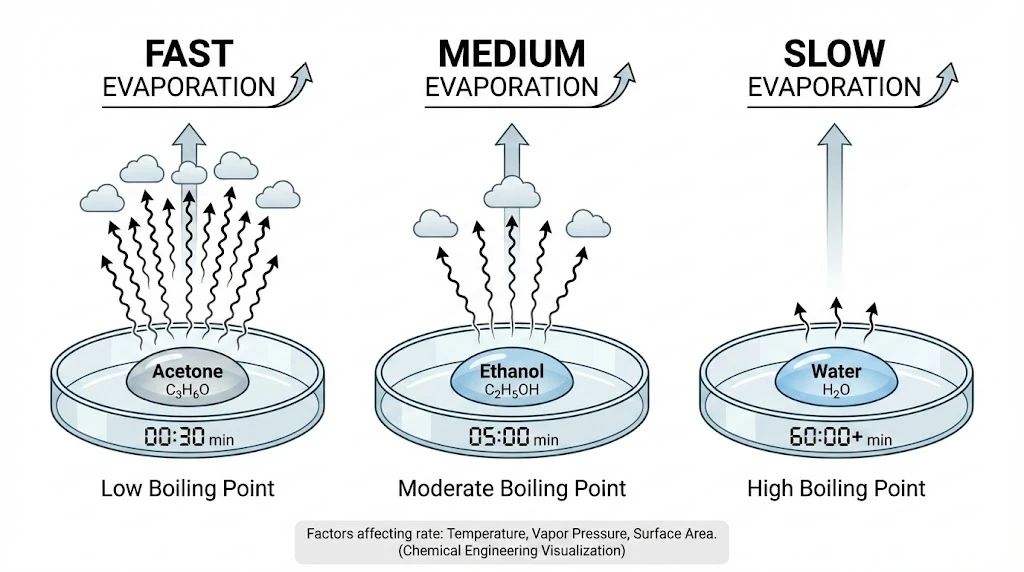
Evaporation Rate and Drying Control
Evaporation speed directly affects:
- Spray wetting
- Film leveling
- Open time
- Cleaning strength
Fast solvents (acetone, IPA): quick drying, risk of dry spray
Medium solvents (ethyl acetate): balanced flow
Slow solvents (mineral spirits): better leveling, slower dry
Most industrial aerosols use blended solvent systems to balance spray quality and drying.
Safety and Regulatory Considerations
Solvents also determine:
- Flammability classification
- Transport regulations
- VOC emissions
- Worker exposure limits
Regulatory frameworks include:
- BIS and PESO (India)
- REACH and CLP (Europe)
- EPA and OSHA (USA)
Aerosol Binders (Resins) – The Film Formers
Binder performance is only realised if the film is delivered correctly, which makes resin choice inseparable from valve and actuator design; the delivery side is covered in how aerosol cans work.
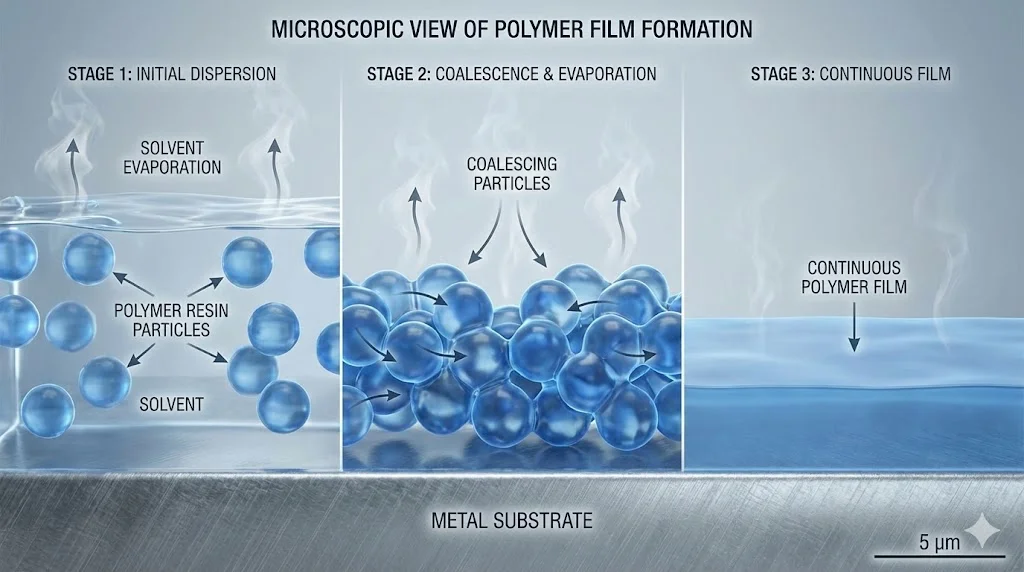
What Does a Binder Do in an Aerosol?
A binder is the non-volatile polymeric material that forms a continuous solid film after solvent evaporation. Without a binder, most aerosol products would:
- Fail to adhere
- Have low durability
- Offer no protection or mechanical strength
Binders are mandatory in:
- Spray paints
- Protective coatings
- Adhesives
- Conformal coatings
Major Binder Types Used in Aerosols
Acrylic Resins
- Fast drying
- Excellent gloss and color retention
- Used in spray paints and decorative coatings
Alkyd Resins
- Good flow and leveling
- Used in general-purpose enamels
- Longer drying time
Epoxy Resins
Epoxy resins offer excellent chemical and corrosion resistance, which is why they are used in primers and industrial coatings rather than decorative topcoats.
Polyurethane (PU) Resins
Polyurethane resins combine high flexibility with abrasion resistance, making them the usual choice for specialty performance coatings.
Binder Selection Depends On
- Required gloss level
- Surface adhesion needs
- Drying time
- Chemical resistance
- Outdoor durability
- Cost structure
Improper binder selection leads to:
- Low gloss
- Weak adhesion
- Premature coating failure
- Poor recoatability
Surfactants in Aerosols – The Stability Engineers
Surfactant behaviour is what makes emulsion and foam products work, and the same interfacial chemistry governs how a spray wets its target. Where these systems use water, the corrosion consequences for the container are covered in our two-part study of corrosion in water-based aerosol cans.
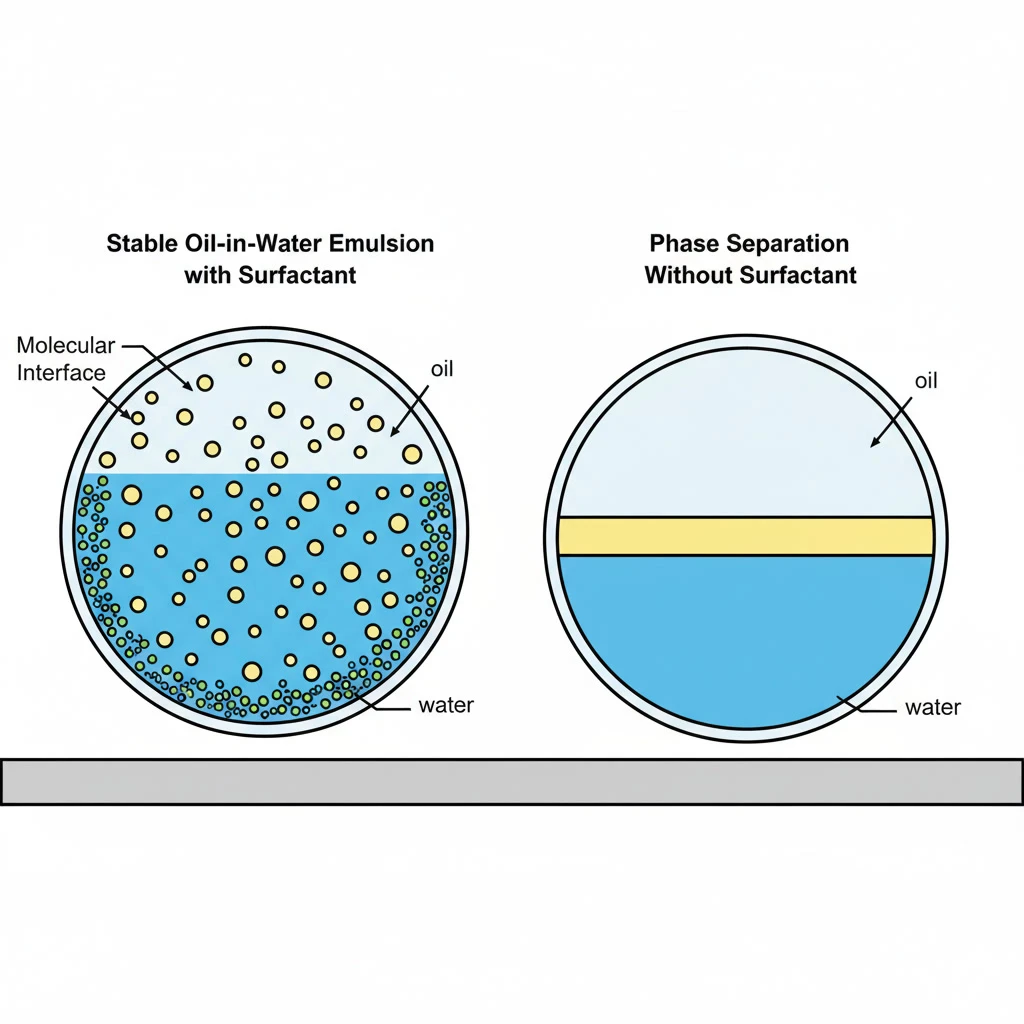
What Is a Surfactant?
A surfactant is a molecule that reduces surface tension between immiscible phases such as oil and water, enabling emulsification, wetting, and dispersion.
Surfactants are essential in:
- Water-based aerosols
- Foaming aerosols
- Suspension formulations
Key Functions of Surfactants
- Wetting solid particles
- Dispersing pigments
- Stabilizing emulsions
- Preventing sedimentation
- Improving spray uniformity
Types of Surfactants Used in Aerosols
- Non-ionic surfactants – chemically stable, broad compatibility
- Anionic surfactants – high detergency, used in cleaners
- Cationic surfactants – antimicrobial, corrosion inhibiting
- Amphoteric surfactants – mild, used in personal care aerosols
Surfactant Selection Is Critical
Incorrect surfactant choice can cause:
- Phase separation under pressure
- Loss of spray consistency
- Valve blockage
- Reduced shelf life
Surfactants must also remain compatible with propellants such as propane-butane or compressed gases.
Aerosol Additives – Small Quantities, Large Impact
Additive and raw-material specifications are normally written against published test methods so that two suppliers can be compared on the same basis; the relevant classification and test standards are maintained by ASTM International and ISO. Where a coating is intended to reduce solvent emissions, the applicable limits for aerosol coatings are set by the US EPA aerosol coatings programme.
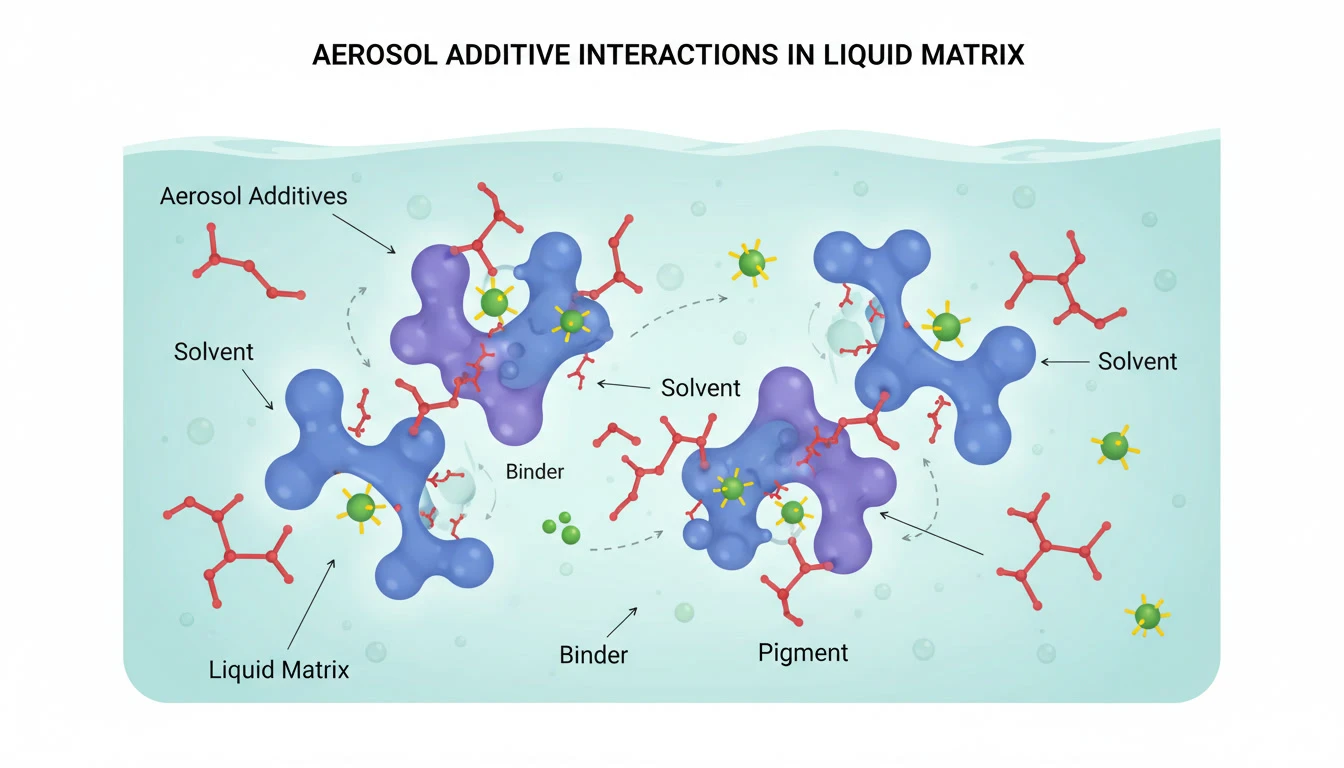
Additives are used in very low concentrations but solve specific technical problems.
Common Aerosol Additive Categories
- Flow and leveling agents
- Anti-skinning agents
- Corrosion inhibitors
- Rheology modifiers
- Defoamers
- Antioxidants
- UV stabilizers
- Fragrances and dyes
Technical Roles of Additives
- Anti-skin additives prevent premature polymerization in paint aerosols.
- Corrosion inhibitors protect steel cans from internal rust.
- Rheology modifiers control viscosity for consistent spray.
- Defoamers suppress unwanted foam during filling or application.
Over-dosing additives can cause:
- Loss of gloss
- Film defects
- Spray instability
- Valve malfunction
How These Ingredients Work Together Inside the Can
The finished concentrate must remain a single stable system for the whole shelf life, which is why scale-up trials are run before commercial filling — the staged process is described in from lab to commercial launch.
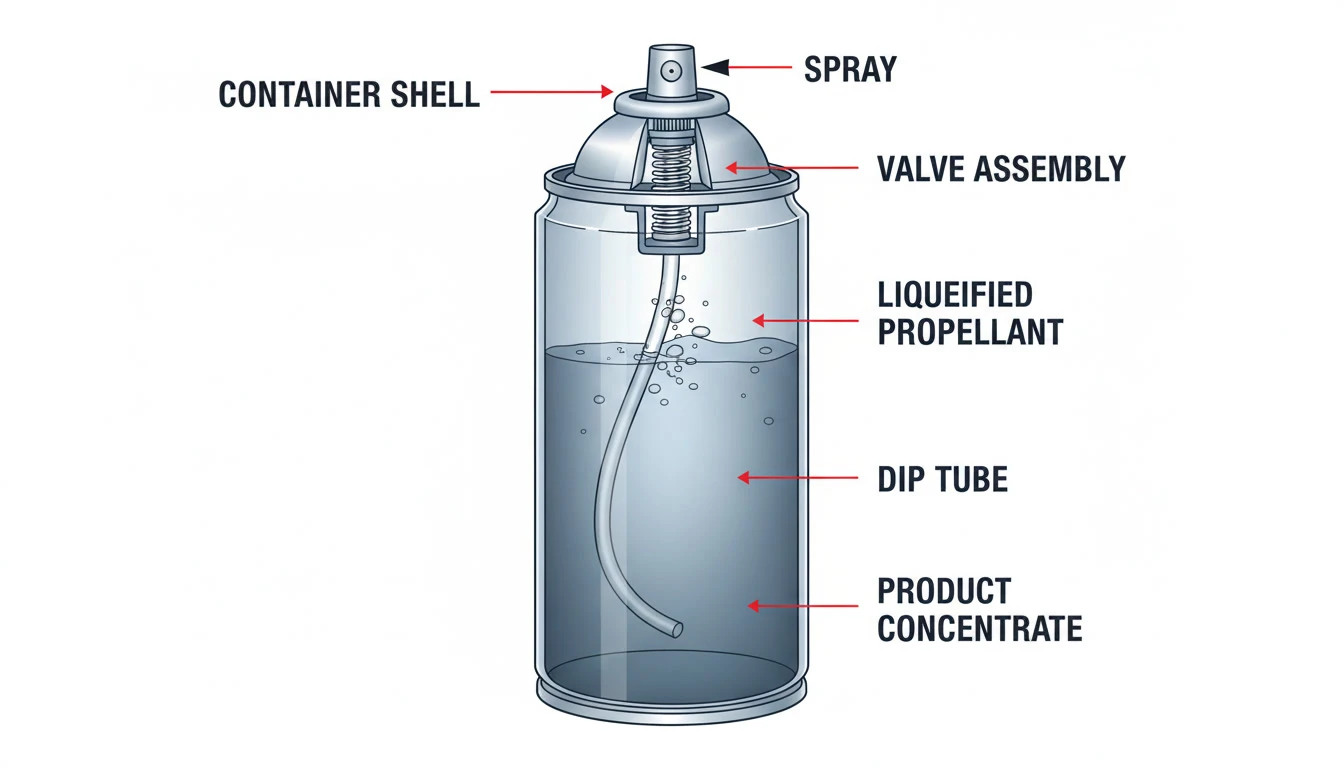
An aerosol formulation is a closed, pressurized, multi-phase chemical reactor. Inside the can:
- Solvents dissolve or suspend solids
- Binders remain dissolved until sprayed
- Surfactants stabilize phases
- Additives fine-tune performance
- Propellant provides expulsion energy and atomization
During spraying:
- Pressure forces liquid through the dip tube
- Rapid expansion occurs at the valve
- Solvent begins flashing off
- Binder forms a film
- Additives modify surface behavior
Any incompatibility in this system results in:
- Poor atomization
- Spitting
- Incomplete evaporation
- Weak film formation
Typical Aerosol Chemistry by Product Category
Different consumer and industrial applications require highly specialized formulation chemistry to deliver the desired performance. From water-in-oil emulsions in personal care to heavy solvent-resin blends in paints and coatings, the chemical properties must be tuned to match the end-use requirements. Below is a breakdown of the typical chemical profiles for the most common aerosol product categories.
Spray Paints
- Solvents + acrylic/alkyd binders + pigments + flow additives
Cleaner & Degreaser Sprays
- Oxygenated solvents + surfactants + corrosion inhibitors
Lubricants & Rust Preventives
- Hydrocarbon solvents + base oils + anti-wear additives + corrosion inhibitors
Personal Care Aerosols
- Water/alcohol systems + surfactants + fragrances + skin-safe preservatives
Industrial Specialty Aerosols
- Custom solvent blends + resins + functional additives
Common Aerosol Formulation Problems and Chemical Causes
Several of these problems present as packaging failures rather than formulation faults. Where a chemical incompatibility attacks the seal or the container, the mechanisms are set out in aerosol valve gasket materials and why aerosol cans leak.
Chemical instability inside a pressurized aerosol canister can lead to severe product failures, from early corrosion to complete nozzle clogging. Many of these issues are not mechanical, but arise from chemical incompatibilities, poor solubility, or unstable emulsion systems. Resolving these formulation problems requires a systematic investigation into their chemical root causes.
| Problem | Chemical Root Cause |
|---|---|
| Phase separation | Poor surfactant compatibility |
| Valve choking | High solids or poor dispersion |
| Poor spray pattern | Incorrect solvent volatility |
| Low gloss | Wrong binder or solvent balance |
| Can corrosion | Inadequate corrosion inhibitors |
| Sedimentation | Poor pigment wetting |
Regulatory, Safety & VOC Considerations (India & Global)
- Flammability
- Pressurization
- VOC emissions
- Worker exposure
- Environmental release
- India: BIS, PESO, CPCB
- EU: REACH, CLP, VOC Directives
- USA: EPA, OSHA, DOT
Aerosol Chemistry for Startups & Entrepreneurs
- Copy-paste formulations
- Low-cost shortcuts without chemistry understanding
- Inadequate stability testing
When to Seek Professional Aerosol Formulation Support
Professional guidance becomes essential when:
- Products show instability during summer storage
- Export compliance becomes mandatory
- Repeated valve failures occur
- Corrosion appears inside cans
- Spray quality changes between batches
Custom chemistry design is also a major competitive advantage rather than using generic market formulas.
External Technical References (For Deeper Study)
- European Aerosol Federation (FEA) — technical guidance and industry standards for aerosol manufacture.
https://www.aerosol.org - Society of Cosmetic Chemists — peer-reviewed aerosol and personal care formulation science.
https://www.scconline.org - ASTM International — published test methods for solvents, resins and finished aerosol products.
https://www.astm.org
Frequently Asked Questions
What is the most commonly used solvent class in aerosol products?
Can water be used as a solvent in aerosols?
What does a binder do in an aerosol formulation?
Why are surfactants needed in aerosol systems?
How does solubility parameter matching help formulation?
What additives are typically used in aerosol formulations?
Need Technical Support for Aerosol Formulations?
Partner with Global Aerosols to audit, scale up, and troubleshoot your aerosol chemistry, canister pressure calculations, filling lines, and safety systems.
Email: consulting@globalaerosols.com
Website: https://www.globalaerosols.com
Phone: +91 9819548320 +91 8169102990
About the Specialist
Absar Khan is the founder and lead aerosol consultant at Global Aerosols. He possesses cross-disciplinary engineering expertise spanning aerosol formulation chemistry, solvent and resin selection, propellant compatibility, and regulatory compliance. Absar leads scientific and engineering advisory teams supporting manufacturers globally in technology selection, GMP layouts, validation frameworks, and regulatory strategies.
LinkedIn Portfolio: Connect with Absar Khan on LinkedIn