Aerosol Scale-Up: From R&D to Commercial Launch
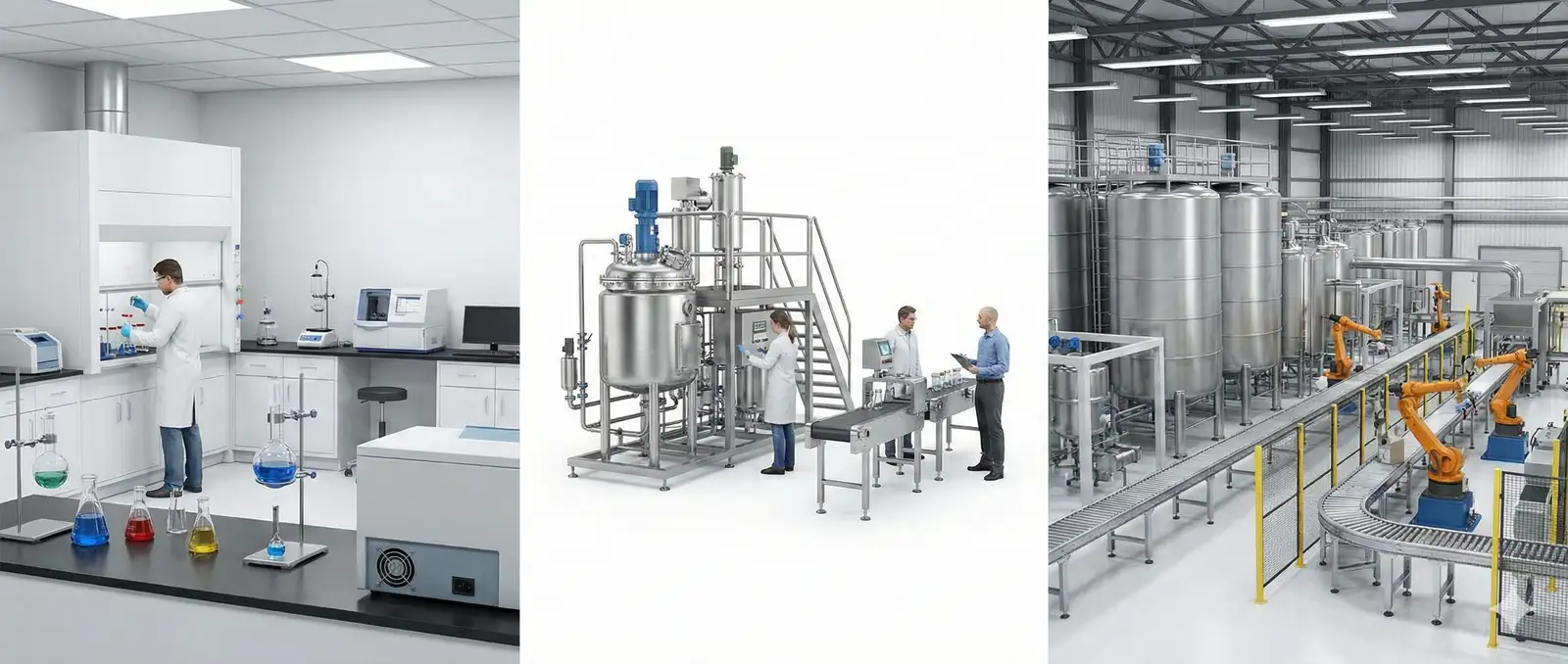
Guide Contents
- 1. Why Scale-Up Stages Matter in Aerosols
- 2. R&D Formulation for Aerosol Products
- 3. Pilot Scale Aerosol Manufacturing
- 4. Commercial Aerosol Production
- 5. Key Differences Between R&D, Pilot & Commercial Scale
- 6. How Aerosol Products Move from R&D to Commercial Production
- 7. Real-World Aerosol Example: Industrial Degreaser Spray
- 8. Which Stage Should You Be At?
- 9. Regulatory, Quality & Compliance Requirements
- 10. Work With Global Aerosols
- 11. FAQs
- 12. Further Reading on Aerosol Science
- 13. About the Author
Why Scale-Up Stages Matter in Aerosols
Aerosol products require a structured and controlled scale-up process because propellant behavior, valve mechanics, pressure stability, and formulation–hardware interaction change significantly with batch size. The transition from lab to pilot scale reduces technical uncertainty, while moving from pilot to commercial reduces operational and financial risk. Companies that treat all stages as identical often face spray failures, leakage, foaming issues, and inconsistent discharge rates during commercial production.
- Prevents unexpected pressure deviation during filling
- Ensures proper valve–formulation compatibility
- Identifies propellant solubility and dispersion issues
- Allows stability validation under real storage conditions
R&D Formulation for Aerosol Products
R&D formulation decisions made here are constrained by the same solvent, binder and surfactant chemistry covered in aerosol chemistry 101, and by which of the solution, emulsion or suspension system types the product actually is.
The R&D stage establishes the chemical and physical foundation of an aerosol product. At this level, small batches are used to identify the correct solvent system, emulsifier system (if applicable), propellant class, corrosion inhibition chemistry, and spray-performance targets. The objective is not production readiness but scientific feasibility and functional performance verification.
- Small-scale screening of solvents, surfactants, and additives
- Preliminary propellant selection (LPG, DME as liquefied propellants; CO₂ and N₂ as compressed gases for pressure adjustment)
- Early spray testing using hand-filled cans
- Short-term stability checks for phase separation
Typical Batch Sizes
- 250 mL – 5 L liquid concentrate
- 10–50 aerosol cans (hand-filled)
Equipment Used
- Laboratory stirrers
- Homogenizers
- pH meters and viscometers
- Bench-top crimpers and gassing heads

Pilot Scale Aerosol Manufacturing
Pilot trials exist to validate the same crimping, gassing and leak-detection sequence used at commercial scale, described in full in our aerosol filling line guide.
Pilot scale is the bridge between laboratory success and commercial feasibility. At this stage, the formulation is produced using semi-industrial equipment to validate heat transfer, mixing energy, propellant dissolution, pressure behavior, and filling parameters. Pilot trials also reveal real-world issues that are not visible during laboratory work, such as foaming during filling or delayed phase separation.
- Validation of concentrate mixing at higher volumes
- Testing propellant loading through pilot gassing lines
- Valve, actuator, stem-bore, and orifice-size compatibility assessment
- Short-term and accelerated storage behavior evaluation
Typical Batch Sizes
- 20–200 kg bulk concentrate
- 500–5,000 filled aerosol cans
Pilot Equipment
- Jacketed SS mixing vessels
- Pilot-scale homogenizers
- Semi-automatic crimpers
- Single-head or double-head gassing machines
Commercial Aerosol Production
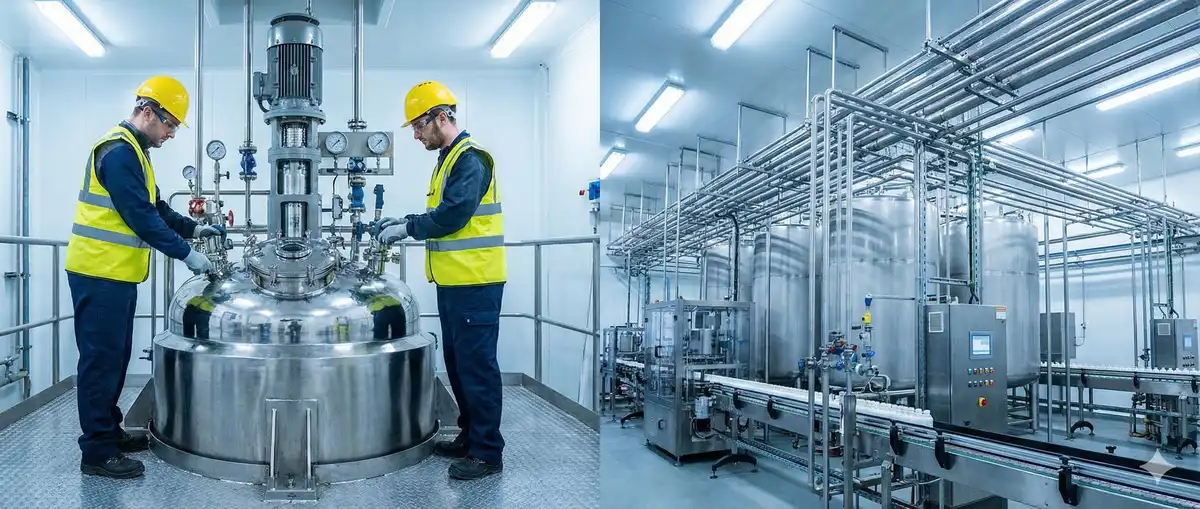
Commercial-scale pressure and burst-test requirements are covered in aerosol can safety, and propellant selection at this stage follows the trade-offs in our comparison of LPG, DME, HFC, nitrogen and CO₂.
Commercial production focuses on consistent large-scale manufacturing while maintaining cost efficiency, quality standards, and regulatory compliance. In standard aerosol production lines, valves are inserted and crimped before propellant filling, except in specific under-the-cup gassing systems. This operational sequence is critical for ensuring filling accuracy and hardware compatibility.
- Automated filling and gassing lines
- High-speed valve insertion and crimping
- Pressure testing and leakage verification
- Vendor-approved raw materials and hardware
Typical Commercial Scale Batch Sizes
- 1–10 tons concentrate
- 10,000–200,000 cans per shift depending on line speed
Regulatory Load
- Full QA/QC protocols for every batch
- BIS/ISO requirements; GMP applies only to pharmaceutical or regulated cosmetic aerosols
- Pressure and leakage testing compliance
- Propellant safety and hazardous-area certification
Key Differences Between R&D, Pilot & Commercial Scale
| Parameter | R&D | Pilot Scale | Commercial |
|---|---|---|---|
| Batch Size | mL–L | 20–200 kg / 500–5,000 cans | 1–10 tons / up to 200,000 cans |
| Objective | Feasibility | Process Validation | Market Supply |
| Propellant Testing | Basic selection | Solubility & pressure behavior | Full performance verification |
| Equipment | Lab tools | Semi-industrial | High-speed filling lines |
| Documentation | Minimal | Moderate | Full regulatory |
| Risk Level | Technical | Process risk | Financial & compliance |
How Aerosol Products Move from R&D to Commercial Production
The scale-up pathway in the aerosol industry follows a structured sequence to ensure hardware compatibility, formulation stability, and safe propellant management. Technology transfer from R&D to pilot is followed by pilot-to-commercial validation, ensuring that each step eliminates a specific category of risk before advancing.
- R&D formulation finalization
- Pilot batch selection and equipment alignment
- Multiple pilot batches for parameter locking
- Propellant behavior assessment across storage temperatures
- Valve and actuator optimization
- Commercial trial batch execution
- Full-scale production validation
Real-World Aerosol Example: Industrial Degreaser Spray
This example demonstrates how a common industrial aerosol transitions through scale-up stages. Each phase reveals different technical challenges—particularly around solvent balance, propellant loading, spray pattern, and can stability. The example below is based on standard industry practices used for hydrocarbon-based degreasers.
R&D Stage
- 2-liter concentrate prepared in lab beaker
- Initial LPG/DME propellant ratio screened
- Spray pattern tested with hand-filled cans
- Short-term separation check conducted
Pilot Scale
- 100–150 kg batch prepared in jacketed SS vessel
- Propellant solubility verified in 50–200 can pilot run
- Valve leakage and crimp integrity monitored
- Accelerated storage testing for corrosion and pressure drift
Commercial Scale
- Multi-ton concentrate batch prepared
- High-speed automated filling and gassing
- Pressure and leakage testing for every production pallet
- Vendor-qualified raw materials and hardware standardized
Which Stage Should You Be At?
Companies often misunderstand their current stage, leading to premature scaling or unnecessary delays. Identifying the correct stage ensures efficient use of resources and reduces failure probability during commercial runs. The following indicators help classify your current level.
You Are at R&D If:
- You have only tested small lab batches
- You are still adjusting solvents, propellant levels, or additives
- No real-world storage testing has been performed
You Are at Pilot If:
- Your formulation is stable in lab conditions
- You need samples for buyer or distributor evaluation
- Valve and actuator performance needs verification
You Are at Commercial If:
- You have confirmed orders and ongoing demand
- Your formulation and hardware are locked
- Regulatory and QA systems are in place
Regulatory, Quality & Compliance Requirements
Transport classification and packaging duties for the finished aerosol are set out in DOT and UN aerosol transport rules. Standardised test methods referenced throughout scale-up are published by ASTM International and ISO, and in the EU the applicable framework is the Aerosol Dispensers Directive 75/324/EEC.
Aerosol manufacturing includes additional safety and regulatory requirements due to flammable propellants, pressurized cans, and hardware-specific performance parameters. Quality systems become progressively more detailed as production scales from lab to commercial.
| Aspect | R&D | Pilot | Commercial |
|---|---|---|---|
| MSDS Requirement | Optional | Required | Mandatory |
| COA Requirement | Optional | Required | Mandatory |
| Stability Testing | Screening only | Accelerated tests | Full storage validation |
| QA/QC | Visual tests | Instrumental tests | Full QC lab with documentation |
| Propellant Safety Systems | None | Basic ventilation | Explosion-proof systems |
Work With Global Aerosols
Global Aerosols provides end-to-end support for companies entering or expanding within the aerosol industry. Our expertise covers formulation development, pilot-scale validation, hardware compatibility, raw material optimization, commercial manufacturing strategy, and safety engineering. Each project is executed using established industrial practices with a strict focus on reliability and compliance.
- Formulation & technology development
- Pilot trials & scale-up validation
- Valve, actuator, and propellant optimization
- Commercial plant setup guidance
- Regulatory & QA framework design
FAQs
Can aerosol production start without pilot trials?
No. Aerosol products must undergo pilot validation to check propellant stability, valve performance, filling behavior, and spray characteristics. Skipping this step leads to high failure rates during commercial manufacturing, because defects that only appear at production line speeds and volumes are never caught at lab scale.
How long does it take to go from R&D to commercial launch?
Depending on the product category, the timeline ranges from around 3 months for simple, low-risk aerosols to 18 months or more for high-performance or industrial aerosols requiring extended stability and compatibility testing. Regulatory approval timelines and the number of pilot iterations needed are usually the biggest variables.
Do formulations change during scale-up?
Yes. Most aerosol products undergo controlled adjustments in propellant ratios, solvent balance, inhibitor levels, or valve selection to optimize performance at commercial scale. These are deliberate, tested changes made in response to pilot-trial results, not ad hoc tweaks made after commercial launch.
What is the main difference between pilot-scale and commercial-scale filling?
Pilot-scale filling runs at low speed on equipment similar in principle but smaller in throughput than a commercial line, which allows close inspection of every unit. Commercial-scale filling must sustain the same crimp quality, gassing accuracy, and leak-test pass rate at full production speed, where a defect that appears once in a thousand pilot units can appear far more often once volumes increase.
Why is stability testing repeated at each scale-up stage?
A formulation that is stable in a lab-mixed batch is not guaranteed to remain stable once it is produced on production-scale mixing and filling equipment, because shear, fill speed, and batch homogeneity all differ. Repeating accelerated storage and compatibility testing at each stage confirms the product mixed and filled at that scale still meets the same specification as the original lab sample.
What causes most aerosol scale-up failures?
Most failures trace back to differences between lab and production conditions that were not tested for at pilot scale, such as gassing pressure consistency, valve-gasket compatibility under sustained production speed, or fill-weight variation. This is why the pilot stage exists specifically to surface these issues before they appear at full commercial volume, when a defect is far more costly to correct.
Further Reading on Aerosol Science
To deepen your understanding of aerosol technology, the following guides provide essential technical explanations useful during formulation, scale-up, and manufacturing.
Types of Aerosol Systems Explained
This guide explains different aerosol system architectures and how they influence spray patterns, stability, and overall product performance.
Aerosol Propellants Explained: LPG vs DME vs HFC vs N2 vs CO2
A comprehensive breakdown of propellant classes, covering solubility, vapor pressure profiles, safety behaviour, and ideal application areas.
An engineering-oriented overview of can mechanics, internal pressure dynamics, valves, actuators, and atomization behaviour.
An introductory guide to industrial aerosol production lines, propellant-handling systems, safety protocols, and quality control procedures.
About the Author
Absar Khan is a senior industrial consultant with cross-disciplinary expertise spanning pharmaceutical manufacturing, cosmetics and personal care, home and institutional care chemicals, aerosols, lubricants, and advanced process engineering. His work integrates multiple scientific and engineering domains, including formulation chemistry, GMP facility design, validation science, quality systems, regulatory compliance, and large-scale manufacturing optimization.
As the Founder and Lead Consultant at Global Aerosols, Absar leads multi-disciplinary scientific, engineering, and regulatory teams supporting industries across pharmaceuticals, healthcare, FMCG, and specialty chemicals, delivering end-to-end solutions from technology selection and formulation development to plant setup, scale-up, validation, and regulatory strategy.
LinkedIn: https://www.linkedin.com/in/absar-khan-aerosol-consultant-and-formulator-78359b162
Need Technical Support for Aerosol Formulations?
Partner with Global Aerosols to audit, scale up, and troubleshoot your aerosol chemistry, canister pressure calculations, filling lines, and safety systems.
Email: consulting@globalaerosols.com
Website: https://www.globalaerosols.com
Phone: +91 9819548320 +91 8169102990
About the Specialist
Absar Khan is the founder and lead aerosol consultant at Global Aerosols. He possesses cross-disciplinary engineering expertise spanning aerosol scale-up, pilot trial design, filling line validation, and regulatory compliance. Absar leads scientific and engineering advisory teams supporting manufacturers globally in technology selection, GMP layouts, validation frameworks, and regulatory strategies.
LinkedIn Portfolio: Connect with Absar Khan on LinkedIn